What is the source of happiness, content and fulfillment? The Amish perspective


Western economies and societies are designed to play ‘lets get more stuff’ to be happy

We can play the game of happiness-contentment-fulfillment (“HCF”) many different levels.  All of us flower in specific landscapes and those landscapes (societies / cultures) determine the HCF level that we automatically find ourselves playing  In the USA and the UK the HCF level has been and continues to be ‘get my hands on more stuff’: more money, higher paid job, more status/power, designer clothes, latest coolest consumer electronics, better car, second car, bigger/better house, second home, vacations, girlfriend/boyfriend, sex……

Why is trap kept in place even though evidence shows that ‘more stuff’ does not make us happier after a certain level of stuff

Why is this the case?  All of us who take part in this game assume (intuitively) that having more stuff will make us happy and the media is happy to supply the hypnotic suggestions to buttress and even create these assumptions.  Governments are happy to go along because making stuff that most of us do not need and which does not make us happy (and can often make us unhappy) provides jobs.  Jobs allow those in power to control the mass of humanity that is not in power.  If you take a look at the economic stagnation facing the West you will notice that less of us are partaking in the drug called ‘buying stuff’ and as a result less stuff is being made, shipped, sold and serviced.  As a result of that there are less jobs and more and more of us are finding ourselves without jobs.  As less and less of us have jobs (and job certainty) more and more of us are questioning the system and especially the privileges the powerful have granted themselves.  In turn the powerful strive to put in place mechanisms (laws, punishments, bribes) to put the powerless back to sleep.  If jobs were readily at hand then these harsh mechanisms would not be necessary.

What goes with being a fish?  The fish do not see the water that they are swimming in.  I could go further and say that the fish are oblivious to the action of swimming – in their world (of thinking and of experience) there is no such thing as swimming.  Put bluntly they do not have access to what they don’t know that they don’t know.  We are in exactly the same situation: ‘we do not know what we do not know’.  One access route to that which ‘we do not know that we do not know’ is interacting with people who are embedded in our reality – they have found themselves thrown into a different reality and take that as the natural way of living.  Which people are sufficiently similar and at the same time sufficiently different: the Amish. So it is with deep interest that I have been watching “Living With The Amish” on Channel 4.

Episode 4: The Amish perspective on happiness and contentment

It is fascinating to look at Amish culture and look at our culture through the eyes of the Amish.  There is so much that I have learned. And in this post I simply want to share with you a conversation between an Amish farmer (Harvey Burkholder, Episode 4) and one of the UK teenagers (George) who is staying with the Burkholder family:

George:  “Would you say you are content ………?

Harvey: “Yes”

George:  “Why is it that farming makes you so happy?”

Harvey:  “You can be happy in whatever you do.  The key to happiness is LOVE.  If you don’t have love, the opposite of love is anger and anger is depression.  If we live in anger or we live in doubt.  If a person lives in doubt he can’t be happy.

George:  “So do you feel having a simpler lifestyle is a key to happiness then?”

Harvey: “A simpler lifestyle plays a big part in happiness because stuff will not bring you happiness.  The more you gain, the more you have, the more you want.  Be content with where you are and with what you have.”

George: “David said yesterday that happiness comes from within.”

Harvey: “Exactly, 100% true.”

Episode 5:  The Amish perspective on riches and community

One of the UK teenagers is speaking with one of the Amish women and conversation takes place that I find fascinating as it discloses what we do not see (or actively ignore) and our society/culture actively downplays and hides:

UK teenager:  “Whilst I have been here I have noticed that everybody is an individual but you have come together to be a community where you value each single person and try very hard to make sure they stay in your community.”

Amish woman: “Riches are fleeting.  What is there to riches?  They can be gone overnight, it happens sometimes. So we do’t build on earthly riches or anything. We build a secure community for our children: the community of tomorrow. So when the children are older they will learn to work together for the good of the community.  And if the community is pulling together then you can really go places.”

My thinking

There is a huge difference between HCF (happiness-contentment-fulfillment) and a number of other phenomena like pleasure, ease, comfort, convenience, entertainment, status, power etc.  In our culture we confuse HCF with the latter – they are NOT the same. If you get this then you can give up the trap that we are automatically thrown into by virtue of flowering into the Western countries.  The door out of the trap is open, it has always been opening – we simply have not pushed on it and walked out.

Remember that money can buy you status and power – not HCF.  If this was not the case then the rich would not be unhappy.   Riches can be you pleasure, convenience, ease, comfort, convenience, entertainment etc – these are distinct from HCF.  The problem with stuff is that it only fills the hole inside (lack of HCF) temporarily – to keep the game going and not notice the lack of HCF you have to keep buying more stuff continuously.  And if you do get present to the fact that stuff does not fill the HCF hole then you turn to sex, drink and drugs.  If that does not work well enough then you take your own life.
On being wanted, loved and cared for: how I arrived with one sister and left with four sisters!


“According to Mother Theresa, the greatest disease in the West is not Tuberculosis or Leprosy; it is being unwanted, unloved, uncared for.” Tim Sanders, Love Is The Killer App

A life full of ‘business as usual’ encounters

Can you remember a time in your life when you turn up at someone’s house because it is something you should do. And as you knock on the door you expect a superficial experience because the people are in the room and humanity has gone walkabout – including your own? My life if it was a container would be full of these superficial encounters: unwanted, unloved, uncared for. And I am confident that I have had the same impact on many of my fellow human beings.

Three extraordinary sisters and an extraordinary day

Yesterday I encountered Asma, Saima and Selena (sisters) as I have done several times before. Yet this time I so enjoyed their company that I did not want to leave and return home. The speaking, relating, listening and the experience of each others company was extraordinary. Full of humanity – genuine sharing, caring and laughter. What was present that had been missing in previous encounters?

I was coming from the context of ‘Playing BIG’ and being the source of powerful conversations that bring the experience of the extraordinary into being. And the people I interacted with (including Asma, Saima and Selena) were touched by my honest sharing (including vulnerabilities and mistakes) and put their humanity into the mix with me. Together we touched each others lives in an ‘extraordinary’ way – definitely not a ‘business as usual’ experience’!

I got that I have four sisters and not three: I simply had not been willing to see this before. Asma is amazing and loves me; I got that Saima is amazing and loves me; I got that Selena is amazing and loves me; I got that they are amazing together and love each other; and I got that they are being loving towards their mother and father.

I love my sister Freda and the relationship is so strong that I have never wanted or wished for another sister. Today I ‘have’ four sisters. Put accurately, I declare that I am an elder brother to four sisters: Fred, Asma, Saima and Selena. And as such I take on all the ‘stuff’ that goes with ‘playing that game’. How do I feel? Great.

Final thought: ‘Playing BIG’ has expanded my circle of concern and of care. And it has also enriched my life I am delighted to be in relationship with four sisters – each of them being amazing.

I love you Freda, Asma, Saima and Selena, Please know that you have a brother in me and all that goes with that. Asma, Saima and Selena I apologise that it took me so long to get that you want, love and care for me as your older brother. I totally get that you are amazing and it is a privilege to step into being your elder brother.

Conversation and fellowship: I am starving how about you?


Dear Simon, Fred, Derek, June, Enzo, Saffron, Zara, Emma, Stefanie, Rohan, Simon, Leigh and James

The last two days of my life I have experienced as wonderful and you have all helped to fill me with joy.  Please know that I consider it a privilege that our loves have touched and that we are family.  Each of you is wonderful and collectively we are awesome.  In can honestly say that this has been the BEST Christmas that I have participated in and experienced in my whole life.  What showed up this Christmas that was special?

The food and drink was great.  Yet that is not what made the difference even though I thoroughly enjoyed the food and totally get/got the love that went into the food and the cooking.  Thank you Simon and Fred for the food, drink and the hospitality.  I felt loved by you before arriving, I felt loved during my stay at your home and I felt loved in departing from your home.

So what was present (as viewed through my experience) that has not been present in previous Christmases?  Conversation and fellowship.  I was throughly immersed in conversation with one or more of you during the two days.  And that communication occurred in the context of GREAT fellowship.  What do I mean?  I mean that we all respected each other and as such treated each other with dignity and respect.  LOVE was present: the human connection was present and that makes a difference to me.  During my time with you we talked about our childhoods, our parents, our friends, our hobbies, our travels… And we shared, explored, discussed but never debated views on morality, justice, economics, politics……  Be being in conversation with me in the spirit of great fellowship you enriched my life – I will remember this Christmas to the end of my days.  Thank you for the privilege of being a part of your life and for sharing your life and yourselves with me.

You have got me present to the fact that I have been starving (for a long time).  What am I starving from?  It is certainly not food or drink.  It is the kind of conversation that we co-created (in the spirit of great fellowship) that I have been starving from!  Conversation – sharing, listening, exploring, learning, connecting through conversation makes a huge difference to the experience and quality of my living.  What is so is that this kind of conversation is totally absent in my day to day living.  Derek and June I know why I love being in your company – it is the great conversation which arises as a result of us having diverse experiences and diverse views within the context of respect and love of each other.  I love you and thank you for the privilege of your company, your fellowship.

Now that I know that I have been starving myself of good conversation and great fellowship (TED is a great and yet a poor substitute) what am I going to do about it.  First and foremost I am creating (right now) the Possibility of great conversation and fellowship.  Second, I declare that I am a STAND and CLEARING  for great conversation and fellowship.  What is left to do is to take UNREASONABLE action in support of this Possibility and Stand.

What do I want from you – my friends and family?  I request that you act as an existence structure (a powerful conscience) that continually reminds me of this Possibility and Stand and moves me to act in alignment with this Possibility and Stand.

I love you.  And that goes for family and friends in the USA (Dan, Lora, Kevin, Dawood, Ray….), New Zealand (Jon, Natalie, the boys), Germany (Frank, Petra, Ida, Paul, Anton, Stefanie), Switzerland (Stefanie), France (Hugues, Suzanne, Aldine, Marco, Clea, Ralf, Christelle, Will, Meme, Lisa, Roald, Beatrice, Michel, Jacqueline, ………….),  Belgium (Tim + family, Karl), Spain (Gloria, Andrew), Thailand (James), UK (Gisella, James, Ansar, Lois, Shamim, Anjam, Amjad, Saima,………), Israel (Arie), Italy (Luciano)…..  I wish you the very best for 2012 and look forward to the day we meet face to face and I have the privilege of your company.


Playing BIG (practice 2) – lose the significance and play


Taking yourself so goddamn seriously is a key piece in the game called ‘Playing small’.

Our automatic (always on) way of being is taking oneself SERIOUSLY because we are thrown into the game called ‘playing small and fitting in’.  Mastery of this game is not beyond me in anyway.  I could say that I became a grandmaster by the age of 10.  The cost of taking oneself so damn seriously is the loss of self-expression: the unwillingness to say and do anything that makes you and I look stupid in the eyes of others.  One side effect of taking oneself so seriously is the quickness to anger when someone does something to ‘diminish’ our sense of ourselves.   Sound abstract?  Let me make it concrete by sharing an example of my life.

I love driving, I particularly love driving fast and without cars getting in my way and slowing me down.  I think of myself as a considerate driver – checking who is behind me, checking that there is enough space for me to overtake into, indicating before overtaking…. you get the idea.  So what happens when someone overtakes me and doesn’t follow my rules?  Usually it is some form of “You moron!” accompanied by either disgust and/or anger.  Why is that moron overtaking me?  How dare he move from his lane into my lane without indicating and into a space that is not ‘long enough’ and so force me to brake to avoid hitting the “idiot”.  As you can imagine people do what they do and so in the course of a normal journey on a motorway I end up disturbing my own piece several times.  Nonetheless I get to be right and righteous – how great I am and how inconsiderate and idiotic some drivers are!

Since I took on the game of ‘Playing BIG’ I have taken on the practice of NOT taking myself so goddamn seriously.  Here are the results I have seen over the last two days:

I have been singing. Yes, I have been singing and in public!  Why is that a big thing?  Because when I took myself so damn seriously I rarely sang and when I did so it was only because my family ‘pressured’ me into singing.  For the last two days I have been singing at my sisters and outside on the high street (whilst shopping).

On the way  to my sisters (90 minute drive) two/three cars just moved from their lane into mine without notice.  We did not have a collision because I was paying attention and so braked.  What did I say?  “You’re welcome!”.  How was I feeling?  Completely calm – in fact once I even laughed when I got present to what I was doing.

Today, coming back from my sisters (after a great Christmas) there was enough traffic to slow down progress on a dual carriageway.  The inside lane was full and I was on the outside lane travelling at around 60mph – the legal limit.  I couldn’t go any faster because there were four or so cars ahead of me and tightly bunched: too close for the speed we were travelling at.  I looked into the mirror and say a car right up my backside.  He sat there for several minutes and then started flashing me suggesting that he wanted to overtake and I should move into the inside lane.  Normally, I would have said something offensive like “cretin!” and made sure that I stayed in the lane and in fact reduced my speed to slow him down even more – to annoy him.

This time I got that all he wanted was to overtake and by flashing his lights and sitting right on my backside he was showing that he was impatient to get somewhere fast.  So I looked for an opening on the inside (slower) lane, indicated and moved into it.  All the time I was smiling knowing that he would overtake me and then find himself in the same position I was in – blocked by a row of cars travelling at 60 mph.   Once he overtook me, I moved back into his lane and sat behind him.  Now I had a choice: to do what he had been doing to me (sitting on my back and making me nervous), simply to be in that lane and leave lots of space between me and him, and/or leave lots of space and have some fun with him without making him nervous or endangering him.  I choose the latter – I simply wanted to play without putting anyone’s life at risk.

For the rest of the journey 30 minute or so he would speed ahead and then pull into the inside lane.  I would overtake him and then pull in ahead of him.  He then would overtake me, I would overtake him.  Never once did I get angry or competitive – I was simply playing a game, coming from the context of fun.  The 30 minutes flew by and by the time I had to take the slip road and exit from the motorway I was grateful that I had the Mini driver to play that game with.  I thanked him.  And I can honestly say I felt sad that the game we had playing came to and end.

Lesson: we can choose to be light and dance/play in life rather than be SIGNIFICANT and take ourselves so SERIOUSLY.   If I choose to be significant and be damn serious then I am automatically embedded in and playing the game of ‘Playing small’.  So being mindful I can choose again and again to ‘Play BIG’ and that means shedding significance and seriousness (they go together) again and again in all domains of life.

Fighting and killing over labels and how to give it up


The situation – we fight and kill over labels

The other day my wife and I ended up in a conversation talking about poverty.  Whilst the conversation started well it quickly ended up with each of us arguing/disputing against the other.  And quickly after that emotions became inflamed and our relationship a distant one for the rest of the evening.  What happened?

When I got thinking about it – during the night – I ended up laughing at the human condition, my condition.  My wife and I had ruined a perfectly good relationship where we felt connected to each other and were being respectful to each other simply over a label ‘poverty’.  What do I mean?  We ended up fighting because I said ” X is poor” and she replied “X is not poor”.  To which I replied that she did not understand poverty as she had not experienced it.  And as such she was wrong and that “X is poor!”  To which she replied that I was mistaken…..

So my wife and I ended up fighting over a label.  How stupid!  How human!  How often do I end up arguing with others over labels?  How often do you end up arguing with people over labels?  And what do we get out of it?  We argue, we raise our voices, we throw verbal assaults, we hit each other and ultimately we kill – all over labels!

When my children were young (less than eight years old) I would play a game with them.  They would make the statement along the lines of “X is good” or “Y is stupid” and I would offer them £1000 if they could show me good and stupid.  And of course they would show me X or Y.  In turn I would point out that they had shown me X and Y – not good or stupid.  Yet here I am 40+ years old falling into that trap myself all the time!

Which are our favourite labels?  They include: good, bad, right, wrong, true, false, me, you, us and them.  If you take a good look these labels and the cognitive and cultural structures that give rise to them are deeply embedded in our way of thinking and acting.  The bizarre thing is that these labels are all made up!  And I should know better than most people having grown up in two very different cultures.

How to give up fighting over labels

The other day one of the family members simply said somethign to the effect “You are critical / wrong / bad”.  Normally, I would tend to respond along the lines of “No, I am not!”  This time I simply said “Yes, I am critical / wrong / bad.” Guess what happened – nothing. The conversation came to an abrupt and peaceful end.  There was nothing for us to work on – to structure to continue the conversation and argue.

How did I end up there?  I simply got that when you make the statement “Maz you are bad” you are not describing reality.  No, you are giving me access to how I land for you in your world.  So your statement gives me access to the reality of your mind.  And who is the expert on your mind?  You are!  So if you say that “Maz you are bad” then I can simply say “Yes, you are correct.” because you are – in the way that that the world occurs to you.

Key insight: all statements are ultimately about how I see the world and not the world itself

The key takeaway is that most of us most of the time are not making statements about the world.  No. We are simply describing our world and how things land for us.  If we can get that then we can give up fighting and killing over labels.

Beyond ‘looking good’ and avoiding ‘looking bad’: embracing the ‘dark side’


As human beings we are not individuals.  This probably occurs as shocking and offensive statement to many brought up in the USA and the UK.  For people brought up in other cultures like say Japan and even the Mediterranean countries like Spain, Portugal, Italy and Greece this statement is rather obvious.

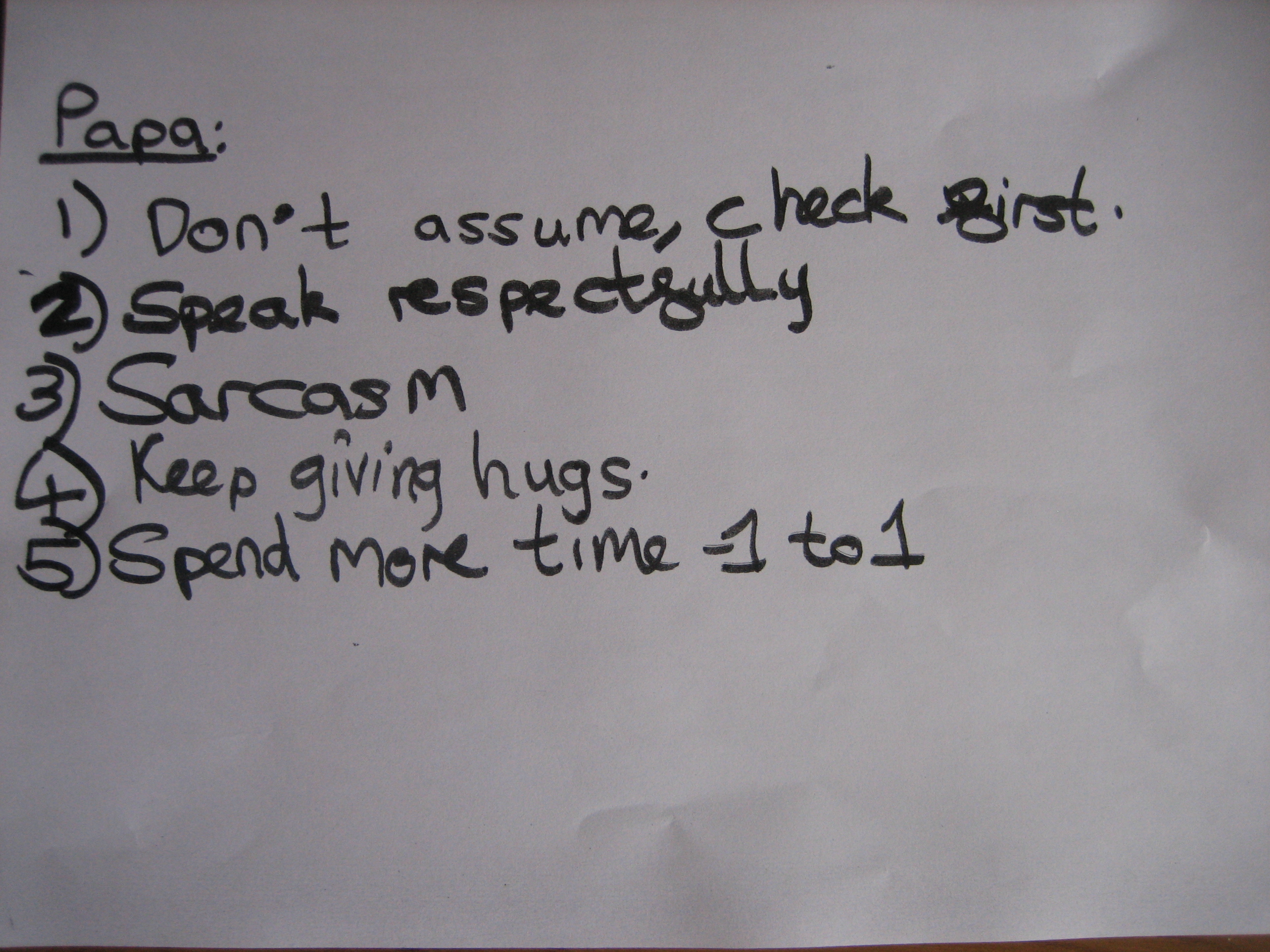
In a nutshell each of us is living in, totally immersed, in a social content and as such we strive to ‘look good’ and avoid ‘looking bad’ in this particular context.  That goes for me too!  So whilst I want to be a wonderful (enlightened, considerate, generous, compassionate, kind) human being, it can be argued that I fail more than I succeed.  This was brought home to me recently when I received the following gift from my son:

PapaNow I can take that many ways.  I have chosen to see this as gift in two senses.  First, it bursts the bubble (I or anyone else may have about me) and thus encourages humility in me.  Second, it shows me the work that there is for me to do.  Specifically:

  • To check and not assume especially when things are difficult or not as I wish them to be;
  • To speak respectfully – at all times, under all circumstances, to all fellow human beings;
  • To avoid sarcasm – which is another way of saying ‘to treat my fellow human beings’ respectfully;
  • To keep giving hugs – which I love to do’ and
  • To spend more 1 to 1 time with my family members.

We all have a dark side. And it loses its hold over us if we accept that is the case, embrace it and work with it.  So I am going to give that a go.

On being wrong or giving up your point of view


I had, in my opinion, a difficult upbringing.  What got me through it was the conviction that my parents (their beliefs, their culture, their practices) were narrow minded and plain wrong.  And that I was right: more open minded, more tolerant, more widely read etc.

Since that time I have made a life out of being right.  I have read on philosophy, psychology, sociology, neuroscience, history, politics, religion etc.  I have spent three months or so reading a whole collection of works to get to grips with Islam (the religion) so that I could prove my parents to be ignorant and wrong.  And of course I did and it felt great.  Yet, it did not help me to build a bond of mutual respect and affection.

It is interesting, for me, to realise that I ended up in consulting.  What are consultants great at?  Being right: we know what you should do, how you should do it, when you should do it, the right process and tools to use.  Put differently, I have made a living out of being right.  And so it is no surprise that the action that I find the hardest is to “give up my point of view” and accept that my point of view is one amongst many, many points of view: specifically that I am too simple to comprehend the complexity and dynamic nature of life.

Then I came across the following TED talk, which I encourage you to watch and listen to:  On being wrong.   Here are some key quotes:

  • Kathryn Schulz: “This attachment to our own rightness keeps us from preventing mistakes when we absolutely need to, and causes us to treat each other terribly.”
  • St. Augustine: “I err therefore I am.”
  • Buddha = Schulz + Augustine: “Ignorance is the root cause of the cycle of existence and suffering.”

If you have not already done so then I urge you to watch the following TED video on empathy: A radical experiment in empathy”.  I recommend that you first watch “On being wrong” and then watch “A radical experiment on empathy”.  Put differently, if I can accept that I may be wrong then it helps me to get the other – to empathise.

I thank my friend Arie for extracting the following from the TED empathy video:

“Step outside of your tiny little world.

Step inside of the tiny little world of somebody else.

And then do it again, and do it again, and do it again.

And suddently all of these tiny little worlds they come together in this complex web.

And they build a big complex world.

And suddenly without realizing it

you’re seeing the world differently.

Everything has changed.”
To sum it all up

Accepting and standing in the circle that “I could be wrong here, how I perceive and think about stuff is only one way of doing so” is the access to not only wisdom but also to empathy and through that to better relationships, more love and joy in our lives and finally a better world.   Then again, I may have got it totally wrong!


How one simple practice can help build strong relationships


I have been married to the same woman for over 15 years and we have known each other for longer than that.  Over that time we have gone through the roller-coaster of relationship many times: spring, summer, autumn and winter.  There have been times when we have created and bathed in a delightful relationship.  There have been times when the relationship has been simply ok.  And there have been times when it has been so painful that I have wondered how I got myself into the relationship and into that position.

Recently, I have noticed that my relationship, my relating, with my wife has gone up dramatically.  And all because we have incorporated a practice into our lives.  Because it works so well I want to share that with you.   Here is how this practice works:

  • Twice a week, every week, we spend time together and talk about our experience of our relationship.  What is working, what is not working, what can be improved.
  • We are clear that the purpose of these sessions is to build the relationship and not to simply vent. And so any sharing has to be mindful.  Yes, I can share what my wife did (Teh behaviour that occurred), how it landed for me and how it has left me feeling.  No, I do not give myself permission (nor does my wife) to  label, criticise or condemn her.  Why?
  • Because we have agreed that we will listen to each other as persons of worth – each of us being up for building a loving relationship and going about it as best as we can.  And so any behaviour that does not contribute to that is open for discussion but not the worth, the dignity, the motivation of the other.
  • We start by checking in and compliments.  Checking in is simply getting present to where you are at in the relationship. Specifically, are there any issues, grudges, resentment, anger that stands between me and my wife.  Once I have shared this then I get present to what specifically my wife has done that has made my life easier, better or simply enjoyable.  Then I share that with my wife and thank her.   Then she does the same.
  • Next, we take turns to share whatever stands between us – the irritations, the disappointments, the upset, the grudges, the frustrations etc.  And we do that using non-violent language.  In the process, I may find that I have done something that has landed badly for my wife and I had simply been unaware of it.  For example, I may have made a casual remark that hurt my wife’s feelings.  When that happens I tend to be genuinely remorseful and apologise.  That tends to be enough for my wife because she gets that it is genuine.  On the other hand it may be that I am asked to do something that my wife needs me to do.  Or to stop doing something.  We discuss, we understand, we make requests, we come to an agreement.
  • During our talk, our sharing, we have agreed to focus on specific events and behaviour that happened between the last time we talked and this time.  That means that we tend to be talking about stuff that happened in the last three days.  I find that really works for me because I am dealing with specific behaviour rather than generalities and grudges that were born, weeks, months, years ago and have not yet been killed off.

Do each and everyone of these sessions go smoothly?  No.  We have worked out that it is better to rearrange if you are feeling down or simply juggling with so much stuff that you are not in the state of mind to be the kind of person you need to be to honour these sessions and make them work as intended.  Have these sessions helped us to understand each other, to empathise?  Yes.  Have these sessions helped more love enter into our lives?  Absolutely.  Do we listen to each other differently every day?  Yes and that makes all the difference.  It is amazing what can grow when you listen to each other as persons of worth up for and playing the game of lets build a great relationship, a great life.

Here is a link to an interesting talk on TED.  It is all about walking in the shoes of the other and how that builds understanding.  I suspect that is what we are doing through these sessions.

Why we all love our friend Shaky


This weekend our friend Shaky popped in and lit all of us up and our home like beautifully laid out lights on a Christmas tree!

Each of my three children love spending time in Shaky’s company.  My wife loves spending time in Shaky’s company.  And I love spending time in Shaky’s company.

What is Shaky’s secret?  Does he have a bag of tricks and techniques?  Has he been to charm school?  Perhaps he has read the latest books on how to build great relationships? The answer is much simpler.

Shaky loves people and he makes you feel special.  How does he do that?

  • When Shaky is with you he focusses on you and does what you want to do, talks about what you want to talk about;
  • Shaky accepts you just as you are and as you are not – no judgement, no evaluation, no criticism, must plain acceptance and validation;
  • Shaky is gentle – he speaks gently, he moves gently;
  • Shaky will enter into a conversation with you and share is point of view yet he will never argue, criticise or condemn your point of view;
  • Shaky never looks towards your wallet – he is always the first one to take is wallet out and pay and we have to fight to pay;
  • Shaky never complains – never complains; and
  • Shaky always offers a helping hand – he never acts like a guest, always like a family member.

We love you Shaky.  We are sad to see you leave our home today.  And we are looking forward to being in your company again.

Finally: I thank you for the gift that you gave me this weekend.  The gift of your friendship and the gift of helping me to better understand myself – and be a better human being.  I look forward to seeing you soon.

An insight into myself: I prefer ‘I-Thou’ and feel uncomfortable with ‘I-It’


There are often times that I have struggled to live and feel comfortable in England where I have spent most of my life and the country that is home.  Having had the fortune to travel, I have noticed that I have felt more comfortable in other countries such as Spain, Italy, Portugal, France and even Pakistan.  Why?

To use Martin Buber’s insight, I believe that I am more inclined toward the ‘I-Thou’ orientation rather than the ‘I-It’ orientation.  What does that mean in plain English?  It means that I am most comfortable treating my fellow human beings as fellow human beings in themselves. And not as objects or roles.  It means I welcome the warmth and hospitality that I experienced in Spain, Italy, Portugal……  It means that I struggle when human beings are described and treated as resources.  It means that I feel most comfortable when I look up and treat the waiter or waitress who is serving my food as a human being rather than an object – a person fulfilling a role.

Perhaps it is not the English culture or society.  Perhaps, it is just that I have spent so much time in corporate business where human beings are simply objects fulfilling roles and/or executing tasks.  It is telling that, at best, they are defined as Human Resources – resources that simply come in a human shape.  That has never sat well with me.

I remember the first time I noticed this, I must have been between 16 – 18 – the age when I started going to discos.  I assume that I was as hormone charged and attracted to the young women there as my friends.  Yet, I did notice a difference.  My friends saw and talked about the young women there as objects and commented on them as such.  And of course their aim was conquest.  I remember thinking that they were talking about human beings as objects – as lumps of meat.  And it did not sit well with me.  What I saw, right in front of me, were human beings: someone’s daughter, someone’s sister.   Whilst this may sound daft, I considered how I would feel if these friends of mine were talking that way about my sister – even though I did not have a sister at the time.

So maybe that is why I was touched so deeply when my son wrote “I love you, Papa” on the computer screen and left it for me to see before I went to sleep; earlier in the evening I had spent some time in helping him with what he enjoys doing – trading via eBay.  He had asked me for help, I provided it.  He asked me for my credit card and I provided it – I simply trust him to use it wisely and he does.

Perhaps, it is because I value my fellow human beings that today on my birthday I am thinking of friends, clients, colleagues old and new.  John, Natalie, Kate, Ray, Dan, Laura, Wil, Hailey, Ruth, Thakor, Manoj, Dawood, Phil, Pooja, Justin, Lina, Chas, James, Catherine, Rosemary, David, Kevin, Mel, Ansar, Fred, Simon, Derek, June, Hugues, Suzanne, Ralf, Meme, Joyce, Michel, Gayton, Jean-Claude, Dave, Tim, Gisella, James, Aldine and on and on.  Who has not touched my life?  I thank each and every person who contributes to my life.  Thank you, the world is a richer place for your existence.

This morning when I woke up my daughter danced into the room to wish me a happy birthday.  And I asked her what three things she liked about her daddy, that made him special to her.  This was her reply:

  • Kind and loving
  • Peaceful
  • Always there so I see lots of him
  • Enjoys spending time with me

That made my day.  And then I got to the computer and found messages from  friends near and far. I thank each of you, send you a big hug and look forward to when I will see you again and give/receive a hug.

On what really matters in life


I have always been interested on figuring out what  the right way to live is.  Largely that was due to the fact that I grew up in two cultures that did not see eye to eye and so I was forced to look at life from an early age.  As I grew up I got into world of self-development, psychology and philosophy.  And all I found was that there is broad array of opinion on how to live and most of it is theoretical.

I have often thought that the best way to figure out how to live is to speak to people who are on their way out.  So what do our fellow human beings who are dying wish they had lived/done differently?   Five things:

  1. I wish I’d had the courage to live a life true to myself, not the life others expected of me
  2. I wish I had not worked so hard
  3. I wish I’d had the courage to express my feelings
  4. I wish I’d had stayed in touch with my friends
  5. I wish I’d allowed myself to be happier

Where did these come from?  They come from a lady that worked with / took care of these older folks.  I encourage you to read the full article as it really is worth reading:  Regrets of the Dying

On the importance of family and friends


On Monday morning at 5am I dropped of my wife and children at Gatwick Airport so that they can spend a week with their French family sking in the Alps.  And when I dropped them off I was thinking “Great, I am going to get some peace and so can get on with all the stuff that needs to be done.”  During the working week that worked out just fine:  I had lots to do at work and I got on with it.  In the evenings I either wrote, I read or I watched a movie.   I even reached out and talked with a friend or two in distant lands by using Skype.  I was alone but did not have the time to be lonely.

Today, I am not busy and I have already done all that needs to be done.  And so I am alone with myself.  Being with that I totally get that whilst life has been peaceful and easy this week, it has also been without any sunshine.  I have missed and do miss seeing the faces of my wife and children.  I miss hearing their voices.  I miss getting and giving hugs.  Today, I am both alone and lonely.

Now I am totally ok with this feeling.  Because I know that I will be picking up my wife and children on Monday morning.  And I have already arranged to go and see my sister and her family this weekend.

Nonetheless, I feel for all the people in this world that are alone and lonely and have no-one to turn to.  I wish I could share a tea/coffee, some food and conversation with you and drive out the loneliness – even for a little while.

On relationships or why I simply love Rosemary!


How you ever stopped to really consider what is a ‘relationship’?

Do you think of ‘relationship’ as a  solid object that once created lasts for a long time, perhaps even an eternity?

Do you think of a  ‘relationship’ as being like a holiday – a clear starting and end point and in between there is lots of adventure, excitement, novelty and fun?

Do you think of ‘relationship’ as communication – talking, discussing, debating?

Do you think of ‘relationship’ as a meal around a table – the meal has to be created, the people invited to the table and there is sharing of food and conversation?

I realise that I have thought of my relationship with my wife as rather like an enduring object.  We created that object many years ago and having been created it should simply last.  After all we have been together for some 19 years.

Today, a wise friend (Rosemary) reminded me about an aspect of ‘relationship’ that I had perhaps never realised and if I did do so then I had certainly forgotten it.  She stated “A relationship needs to fed and nurtured”.

Yes, a relationship has to be fed and nurtured.  And that reminded me of gardening.  When I plant a seedling it needs lots of attention in the form of feeding an nurturing (light, water, heat etc).  As the seedling grows into a young plant it still needs feeding and nurturing.  As the young plant grows into a strong and healthy established plant, it still needs feeding and nurturing. All that changes is that the both the volume, regularity and form of that feeding and nurturing.  If you forget this and fail to feed and nurture the plant, even a strong established healthy plant, it will wither and die eventually.

I realise that to date I have had a mistaken picture of some of my closest relationships.  Thinking that they are now well established plants, I have mistakenly assumed that they no longer need to be fed and nurtured – they can look after themselves.  Thankfully, these relationships are not dead, simply withering and looking for some tender care.  That is my commitment: to give that care in the form of regular feeding and nurturing.

Thank you Rosemary for awakening me from my sleep!

On compassion: or why I am so proud of my son


This is an old picture of  eldest son Rohan, his arrival into this world completely changed my life.

For the first ten years or so of his life Rohan and I were close, almost inseparable.  Yet for the last five plus years we have drifted apart partly because I have labelled him as “inconsiderate and mean”.    Yesterday, my son tore this story into shreds before my eyes.

I had just parked the car at the local fish and chip shop and Rohan went to buy fish and chips for the family.  Whilst he was in the shop an old woman walked slowly with a stroller into the shop.  In the car I could not understand what was taking Rohan so long as he had already been served.

Some minutes later he came out of the shop and walked with the old woman.  When they got to the road, he checked for traffic, held her hand and then walked her across the road and toward her home.

I also found out that he had given the old woman some money as she did not have enough money to pay for her order.

When I asked him why he had done what he had done.  He simply said that he felt sorry for the old woman.  She was alone, she found it difficult to walk, she was partially blind, she did not have enough money….And that had upset him and so he set out to help her as best as he could.

I am so proud of you son.  And I apologise for losing sight of the wonder that is you.  I hope that you will forgive me.

How to lift oneself, one’s family and friends


This week I got to spend some time with my youngest brother.  When I look at him I see that he lives a difficult, demanding life and yet he lives it gracefully.  As I reflected on how he has three set of competing demands – the business, his elderly parents who need care, his young family – I truly got how amazing he is.  And how fortunate I am in being his brother.

When I got the beauty of my brother I told him:

  • I love you;
  • I am proud of you;
  • I believe in you.

I know he was touched – I saw it in his eyes.  And I was touched.

Maybe creating a better world is as simple as that.  Reaching out to our family and friends and looking for the positive.  By looking for and expressing the positive we can lift up oneself, one’s family, one’s friends, one’s fellow human beings.

On how I avoided the warm embrace of conflict


This morning I wanted to study and I chose the kitchen as it was the most suitable place.  I would have preferred to do it in the lounge and yet that was taken by daughter who was watching television and my wife who was doing some ironing.

Just to mentally move from my favourite place, the lounge, to the kitchen I had to give something up.  Specifically, I had to give up the idea that as I pay the bills then I should get to call the shots.  That I am entitled to have the lounge irrespective of the wishes of ‘others’.

About twenty minutes into my studying my youngest son came into the kitchen – he had slept in – and joined me at the breakfast bar.  I did not mind this as there is more than enough space.  Then he did, what he always does: he started singing.  I noticed that his singing distracted me and I did not like it.  Yet, I did nothing.  My son continued singing and I started to get emotional.   The thought that entered my head was along the lines of how inconsiderate my son is: does he not get that I am studying?

I tried to put the distractions aside and focus on my studying hoping that my son would soon finish his breakfast and leave.  Well, this son is never in a hurry to get anywhere.  So the point arrived when I had reached my breaking point.  Thankfully I was still in a rational and relatively calm place and saw that I had options.  I could scold my son for being insensitive and disrespectful.  I could just get angry and tell him to leave the kitchen.  I could continue to sit it out in the kitchen.  Or I could simply leave the kitchen – without resentment – and find another room to study in. I chose the last option.

What I took away from this encounter was the following:

  • I had to give up the thinking that said I should get my way because I am the one that pays the mortgage;
  • I had to give the thought that said I am entitled to special treatment in the kitchen because I got here first;
  • I had to give up the thought that I was owed special treatment – silence – by my son;
  • The thought that my son is simply having breakfast where we normally have breakfast came in handy;
  • The thought that my son is simply doing what he loves to do and is often not aware that he is doing – singing;
  • I was attuned to my emotional state and how it was becoming hotter  and took action before it went past the point of no return;
  • I chose to live and let live – to relinquish my ‘claim to the kitchen’ – as that struck me as the most workable solution that would not put a dent in the relationship between myself and my son.

Put differently, the situation itself was not the issue at any time.  The cause of conflict was primarily my thinking about how things should be and how I should be treated by reasonable family members.  When I gave up that thinking and embraced better thinking I solved the issue with no conflict, no damage to anyone or any relationship!

On speaking


As human beings we speak.  Some even argue that language is what sets us apart – makes us uniquely human.  Yet, it is a gift that most of us are born with and simply take it for granted.  Very few of us really think about this gift and how best to use it.  It kind of reminds me of the community that I grew up in – the muslim community.  Almost everyone was born into and embraced the rituals yet almost no-one had any knowledge or understanding of the genesis of Islam nor the social reform and human centred values that were the foundations of Islam.

So we have a gift – this ability to speak with our fellow wo/man and be understood if we speak the same language.  Now the question is what frame can we put around this gift of speech, of communication?  More importantly, what is the most beautiful use of this gift?

When it comes to frames we have many choices. We can simply put no frame around it and continue as we are: spraying our words all over the place, they land where they land, they have the impact that the have.  We describe stuff, we make up explanations, we complain, we criticise, we gossip behind each others backs, we make up lies, we provide directions, we command, we compliment, we give form to our dreams and so forth.   This is the hidden, taken for granted, frame which gives form to our speaking.

I’d like to suggest a very different frame.  What if each of us, even most of us, were to view gift of speech in a radically different way?  What if we reserved speaking for creating affinity, affection and connection with our fellow human beings.  For example:

  • we share our likes and dislikes and what we want and need from our fellow human beings instead of criticising others – what they have or have not done;
  • giving ourselves and our fellow human beings wings to pursue our interests, ambitions and dreams instead of squelching them out of fear, jealousy or spite;
  • creating affinity and connection with our fellow human beings through acceptance, validation and the generally sharing of our humanity as opposed to creating distance and hatred which is all to common when we criticise, condemn and diminish our fellow human beings;
  • inspiring ourselves and our fellow human beings to bring the best of our humanity – benevolence – into fruit more often in a wider range of situations;
  • providing information – without preaching – that our fellow human beings are likely to find useful in living a good life;
  • to bring into being the kind of world that we want to live as illustrated by the Declaration of the Rights of Man and of the Citizen;
  • talking about and resolving our differences in a way that recognises our need to find solutions that work for us all.

I am suggesting a frame in which our speaking is such that we do not attack, invalidate, exclude and criticise our fellow human beings.  What kind of a world can we create if I was to step into this frame?  And if you were to step into this frame?  And we were to step into this frame?

How about starting the practice, right now, for now to the New Year?  Are you willing to give it a wholehearted go? I am and I hope that you will join me. if you think that this is easy for me then you really do not know me that well!  I have been immersed in the language of criticism from the age of 5 and I mastered it a long time ago.


On Christmas


When I was young, living with my parents, Christmas was simply not being at school and being able to watch lots of interesting / entertaining stuff on the television.  I particularly enjoyed watching action moves. We did not celebrate Christmas as my parents are Muslims.

When I was at university, Christmas was an opportunity to be with my parents, my brothers and my sister.  I remember taking them out to Pizza restaurants and just eating and laughing together.  Occasionally, it was an opportunity to go to a friend’s house and celebrate Christmas with his family.  The friend that comes to mind is James Harvey.  And I thank him and his family to introducing me to an English Christmas.  I enjoyed meeting James’ mother, father, sisters, nephews etc.

When I started my professional career and was single, Christmas was an opportunity to simply be.  To take time out and reflect on the year that had come to an end.  And to think of the year to come.  It was also a time to read books, watch movies and go spend time with friends and family.  I do not remember ever being focussed on buying stuff or receiving stuff.

When I got married into the French and started family, Christmas became a day spent driving to the centre of France.  And once there is became an opportunity to eat fine food and drink fine wine.  Sit at the table, for what seemed like an eternity, and now and then catch flakes of conversation.  And of course about giving and receiving gifts.  Firstly, this  occurred as strange and then it became normal.  Yet somehow it did not seem that Christmas belonged to me: it no longer occurred as an opportunity to be me, to reflect, to be thankful, to choose – it occurred as a duty.

How does Christmas occur to you?  Is it something that you have simply fallen into?  Like I have?

I have been rethinking Christmas.  How about making Christmas a time where I/we:

  • think about each and every person that has made a contribution to our life and experience that contribution and write to and/or call each of these people and thank them for their contribution – what they did, what difference it made in practical terms and how it made / makes you feel;
  • remember and acknowledge all the people  we have criticised, we have excluded, we have trespassed against and then say sorry – by writing or by picking up the phone – and asking what it will take to put the past in the past, to get forgiveness;
  • get present to all the grudges we hold against specific people and then get off our high horse and forgive the imagined or real trespass ideally by calling the other person sharing the grudge and having chosen to forgive – to put the past in the past;
  • take the time to get present to all the millions of people around the world that are not as fortunate as we are and then taking some action even if that is to be grateful for all that we have, that we take for granted;
  • to make a dent – even a small one – in the life of even one human being that we know is suffering, who can do with being seen through kind eyes, listened to with kind ears, lifted up with kind words of worth and validation, and touched by soothing hands; and
  • where we acknowledge ourselves as human beings who strive to do good, to make a contribution, to create a good world for ourselves and our children (whether born, or unborn) and accept that despite our best intentions we fail from time to time and yet what counts is that we pick ourselves off the floor and continue to make good on our commitment to be good and do good.

To put is simply, in the rich western world.  Most people need acceptance and validation – just as they are and are not – then they need presents.   Most people need good honest conversations where they can speak freely without judgement then they do presents. Most people need a heartfelt hug more than they need presents.  And yes, some need a helping heart who will give some of the necessities of life.  If you are looking for inspiration then I recommend watching The Blind Side (the movie starring Sandra Bullock).


Forgiveness is a gift that you give yourself


Until recently I had not thought that much about forgiveness.  Firstly because I have been fortunate in that very few of my human beings have hurt me that much.  Secondly, I have been a master at distancing myself from those – a few that – have caused me pain. Thirdly, I have always thought that forgiveness lets the bad guys off and so gives them an incentive to go and do that again – to me or to others.

For a week or so this month anger, frustration, despair and confusion gripped me tightly.  The working day was not so bad as I was absorbed in tasks that consumed me mentally.  Yet, these feelings, these states of mind would grasp me in the evenings.  And all because I had created a story called Betrayal: I played the part of the wronged person and some of the people who are closest to me were the betrayers.

Being versed in existential philosophy I recognised I had a choice.  Continue with the Betrayal story and thus keep creating anger, frustration, confusion and despair.  Or to create a new story.  And whilst I was in this search I happened to read Anger by Thich Nhat Hanh.  The book is subtitled “Buddhist Wisdom for cooling the flames”. The book gave me access to stories that inspired me to step into the ‘shoes of the other’ and to get that if I was feeling hurt, they were feeling hurt.  If I was wrapped up in a story of Betrayal then they were wrapped up in their own story.

So the question arose: who goes first?  Who says I am folding up my story and putting it on the fire?

So I chose forgiveness: I forgave everyone including myself.   Did that make the lives of the people I was angry with easier?  Yes.  Were they the  only people to benefit?  No.  Were they the main beneficiaries?  No.

What I found is that the main beneficiary of this act of forgiveness is me. Yes, me.  Anger, frustration, confusion and despair have flown leaving only peace of mind.  I am at peace with the world and the world is at peace with me: no need to ready the sword to cut others nor the shield to defend myself from others.

So I can honestly say that forgiveness is a gift that I gave myself.

As I human like you I can confidently state that forgiveness is a gift that you give yourself. Even when you choose to break from someone – you can do it in a way that bears no grudges of the past.  In a way that leaves you overflowing with a peaceful mind.

The beauty of business (for me) is the opportunity to connect with & contribute to fellow human beings


I started off in business back in 1986, some 24 years ago.  During that time I have had the opportunity to do work in a number of countries: the UK, France, Belgium, the Netherlands, Finland, Spain, Portugal, Italy, Greece, Canada and the USA.  And I have done so many different types of work in many different industries.  Yet, today, when I think of my life in business all I care to remember is the personal: the times, the conversations, the encounters with my fellow human beings.

I remember the staff working in the Dixon motor dealership in Morecambe back in the early 90s.  The Dixon Motor Group had gone into receivership so one morning I turned up unannounced and told them something to the effect “as from now you work for the receiver and that means me”.  I had never done this before and was feeling nervous, yet, the people were gracious, warm and worked with me to run their dealership.  When the time came to go on to my next assignment I felt that I was leaving my family behind.  I cannot remember their names, I do remember their faces and their personalities.

I remember the variety of people who I worked with at the London Arena when it went into receivership.  I remember the security guards, the sports centre staff, the cleaners, the admin folks and the sales and marketing professionals.  As I sit here I think of the time when I persuaded some of them to join me and my friends to go paragliding.  It was a fantastic day spent laughing and playing together.  I remember the team spirit – when we all pitched in to stage events such as Smash Hits.

Then there was the Fine English Hotels.  On a cold, snowy day I made my way over to Kent to take over the day-to-day management of this chain of hotels as they had fallen into receivership.  What a bunch of characters I found there – both from the PW team (my colleagues) and from Fine English Hotels.  It was whilst the three of us from PW were working very hard that we got a visit from one of the senior partners.  I remember him today because instead of waiting for us to serve him, he actually served us.  Noticing that the three of us were totally occupied with matters that had to be dealt with there and then – as we had a business to run – he made tea and coffee and served us.  He was leadership in action – rather than talk!

Two events stand out whilst I was at IDV.  The first is stopping and saying hello to the folks that had been recruited to fill the posts that I had helped to create. And in the process making a friend and then two friends.  This friend is Christoph (a German) and through him I made friends with his girlfriend at the time, Peggy.  What led to this friendship was the simple recognition that it cannot be that easy to move from your country to another country.  And so I invited Christoph to have a meal with me and my girlfriend.  Many years later when I was looking for work as an independent consultant, Christoph, who at that time had an influential role in HR, helped me win an important piece of work for the next two years.  He has gone back to Germany and yet I remember him as it was yesterday.

The second event that stands out, is one that lifts me up every time I think of it.  I had the good fortune of having an influential role at IDV and being able to use it to do good.  During the course of my work I came across a 40+ year old man (Peter) who had come in as a contractor to do some treasury work in the finance function.  I struck up a conversation with him and learned that he had family – wife and several young children – and had experienced a difficult six months as a result of having is role made redundant at a former employer.  So when I recognised the time was right I told my boss the Finance Director that it would be a smart decision to employ Peter full-time as he knew his stuff.  And as Peter did know his stuff, he got the job.  To this day, this is one of the acts that makes me proud of myself: I remember the look of gratitude in his face – not to have the worry of asking yourself “how am I going to take care of my family?”.  Wherever, you are Peter I wish you and your family the very best.

I remember fondly my time consulting with Remy Cointreau when I worked for some 18 months with an international team.  I remember Gaeton, the Marketing Director; I remember Stuart the Dutch Finance Director;  I remember Jean-Claude the European Supply Chain Director; I remember Linda, Nicola and so forth.  What a great time we had holed up in Hammersmith designing and then implementing a European shared services centre.  It was an engagement where the business and the personal blended into one.  I remember having a meal at the flat of one of the Italian team members.  Most of us were there and we all cooked and ate together.  Wherever you are friends, I wish you the very best.  I thank you for special memories.

Then there are the folks that I worked with at Sage Publications and Virgin.  I value each of them and consider it my good fortune that some of them are now my friends – at least I am their friend!

I could go on and on – so many people, so many conversations, so many fond memories of the human encounter.  The joy of conversation.  The joy of laughter.  The joy of eating a meal with work colleagues who no longer occurred simply as work colleagues.

So why I am writing about this today.  Well in the late 1990’s when I was co-building the Siebel Consulting practice in the UK, I interviewed many people and had the privilege of offering some of them employment.   As we were struggling to recruit skilled IT consultants within the timeframes and the salaries that were acceptable I came up with and got agreement to recruit suitably skilled graduates – straight from university.  One of the people who I interviewed and then recruited is wonderful chap by who goes by the name of David.  Last week, some 11 years after I recruited him and gave him the “toughest interview of his life” (his words) I had the joy and honour of helping him and his wife to celebrate the arrival of their daughter into this world.  What a privilege to meet Dave and Sarah’s family and friends – to get to know some of them.  I thoroughly enjoyed my day today: thank you Dave and Sarah for a wonderful day.

I have never agreed with the thought that business is business it is not personal.  For me all of life is personal.  What I value most in business is the opportunity to create relationships – even friendships – with my colleagues, with my clients, with partners in the game of business.

Sartre was not on the ball when he said “Hell is other people”.  Yes that can be.  And it is also true that “Heaven is also my fellow human beings”.