On possibility as an access to transformation


What is the access to transformation?  Specifically, what is the access – for you and me – to transform the quality of our living?  Put simply, it is shifting our being-in-the-world, and thus our showing up in the world, from impotent to potent.  What do I mean?  Let’s take a look at the definitions:

impotent

Adjective: unable to take effective action; helpless or powerless

Synonyms: powerless – weak – feeble – helpless – infirm

potent

Adjective: having a great power, influence or effect.

Synonyms: powerful – strong – forceful – intense

Let’s assume that you and I are up for transformation, up for shifting our being-in-the-world from impotent (the default) to potent.  What is the access to making this shift?  Willpower? No, this rarely works as many New Years resolutions show.  Is it setting goals? No, this rarely works because goals tend to rely on the exercise of willpower.  And willpower tends to fade.  So what is a suitable access?

The access to making the shift is inventing and living from one or more possibilities that move-touch-inspire us. Which begs the question “What is a possibility?” A possibility is not a wish.  Nor is it an intention.  A possibility is not a goal, an outcome, an achievement.  Nor is possibility a belief in that which is possible for a human being.

A possibility is like a context from which one shows up and gives life to one’s life.  A possibility is like a stand that one takes upon oneself.  A possibility is like a path that one chooses to walk of one’s own accord and thus gives up the multitude of other paths that are open to oneself.  A possibility is like a declaration one makes on what constitutes one’s life.  A possibility is always a choice one voluntarily takes upon oneself that gives shapes to one’s life and how one shows up in life.

Still looking for a pointer as to what constitutes a ‘possibility’?  Then let me share this quote from Nikos Kazantzakis (author of Zorba The Greek):

“By believing passionately in something that still does not exist, we create it. The non-existent is whatever we have not sufficiently desired.”  Nikos Kazantzakis

And when he speaks of believing he is talking about the following kind of believing:

“A belief is not merely an idea that is thought, it is an idea in which one believes. And believing is not an operation of the intellectual mechanism, but a function of the living being as such, the function of guiding his conduct, his performance of his task.”  Jose Ortega Y Gasset

A possibility gives meaning to one’s life and power to one’s being-in-the-world.  As such it does more than provide one with a reason to get up in the morning.  It provides one the access to transcend one’s psychology and push the limits of one’s biology as and when this is necessary.  It calls forth one to be unreasonable when unreasonable is what it takes.  In short, it the access to living a life that shows up as fulfilling.  A life worth living.

Why do I write this blog as opposed to put my feet up, watch a move, hang out in a bar?  Because I invented a possibility. What possibility?  The possibility of playing BIG, living an ‘extraordinary’ life, of being a source of contribution to a ‘world that works, none excluded’.  How about you?  What possibility leaves you moved-touched-inspired to be and create that which does not exist today?  What possibility are you up for inventing/living this year?

Please note, that all acts of leadership start with inventing a possibility that leaves one moved-touched-inspired to disclose and create that which does not exist today.

Distinguishing love from love


What is this phenomenon called love?  Investigate this phenomenon and you will find that it is not just one experience (phenomenon).  No, it is manifold, many different experiences (phenomena) hidden under one label – love.

What are these manifold experiences housed and mingled together under this umbrella called love?  There is the experience of desire which is more accurately labelled lust. And as lust is not acceptable, given our cultural practices, it is called love.  There is plain sex and that is called ‘love’ or ‘making love’.  There is ownership – in the sense of I have exclusive rights to you, your body, your sexuality, your resources, your time – and that is also called love …. and there is love as in care and caring.

It occurs to me that we would help love to flourish if we reserved love only for authentic care for another.  What kind of care?  Care for their wellbeing – in the physical, emotional and spiritual domains of life and living.  Whilst I can talk about this it is better to get there more concretely.  Allow me to give you an example.

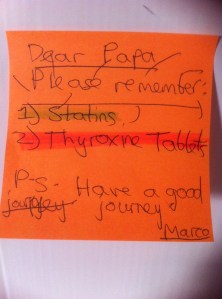
In the morning as I was headed out to spend a few days away from home I was got a surprise.  What kind of surprise?  On one of the doors leading to the outside, a door I have to go through, I found a note for me.  What kind of note?  This note:

photo-3My wellbeing requires me to start the day by taking the Levothyroxine tablet.  And to end the day by taking a statin tablet.  That is just so. And more than once I have left my tablets at home.  So my son, late at night, after I had gone to bed had written this reminder for me and left it where he knew I would see it.  Why did he do that?  Because he cares for me – he loves me.

Now, here is the thing to get.  It is quite possible that my son felt strong feelings of love for me that night.  And those feelings would not have shown up in my living nor made any difference.  Why?  Because I do not have access to his feelings.  I do have access to his actions: I got present to the depth of his love when I saw this post it note and it moved me to tears of gratitude and joy!

I say that contrary to what the songs say love is not a feeling.  No, love is verb – it is doing.  Doing what?  Doing that which contributes to the wellbeing of those we claim to love.  And not doing that which gets in the way of the wellbeing of those we claim to love.

So you and I are confronted with choice: to live from the default context where love is a hodge podge of phenomena or to create and live from an ‘extraordinary’ context where we use the label love to mean love – love as in compassionate caring for the wellbeing of those we claim to love.

What choice will I make?  What choice will you make?  In making our choices we should be mindful that love – as in caring for the wellbeing of another – is the access to transformation: of my live, your life, our lives, of life as a whole.

The day the electricity died, it always dies


My son and I had plans for yesterday.  At the end of his day we were going to cook together, watch a movie, play some music and dance.  In the midst of the evening and our plans the electricity died.  Darkness. Our plans come to a halt!

In the process this thought struck me: what a privilege electricity is!   Walk with me down imagination lane. And imagine what our lives would be like without electricity.  Can you imagine our modern, taken for granted, existence without electricity?

Then another thought, a profound thought, struck me.  Does not electricity give me existence?  And one day, any moment / any day, that electricity will die.  I will be no longer.    There will not be any darkness as I will not be there to witness it.  And so I came face to face with existence: it occurs to me that my life, my existence, is not a right, it is a privilege!

You and I are confronted with a choice.  What is this choice? To continue living from the default context – ‘life is a right’ – and all that goes with it: sense of entitlement for life to provide us with our needs and wants; a lack of joy in our living; a tendency to fritter away our time, our life, on that which does not matter, that which does not give us joy, that which does not make a contribution, in short the banal.

Or you and I can choose to create and operate from the context ‘wow life is a privilege!’.  Operating from such a context we are present to the gift of our existence and as such we are mindful of and make the most of each moment. Gratitude is present.  Aliveness to the experience of being alive is present.  Joy/delight is present.  A sense of adventure is present.  Living, truly living, is present!

Looking ahead and moving into 2013, what choice will I make?  What choice will you make?  Living from the context ‘life is my right’ or ‘my life is a privilege!’?

Christmas: a time to be of service and make a difference?


AldinePhotoChristmas2012

I dedicate this post to my wife, Aldine. For me, my wife is the embodiment of that which I want to share with you in this post.

Christmas can be just a ritual we go through or it can be a time to get present.  Present to  what?  Present to being of service and making difference.  Who to?  How about starting with the people who you/I are spending Christmas with.  And then allowing ourselves to ripple out from there to touch all the people whose lives touch our lives, however briefly and lightly.

What does it take to make a difference?

What does it take to make a difference in our lives, in the lives of our fellow human beings, in the world within which we dwell?  It takes courage. What kind of courage?  Let’s listen to a master of the human condition:

“All it takes to make a difference is the courage to stop proving I was right in being unable to make a difference… to stop assigning cause for my inability to the circumstances outside of myself …… and to see that the fear of being a failure is a lot less important than the unique opportunity I have to make a difference.” Werner Erhard

What does it take to make a difference to the people whose lives we touch?

Our ordinary, default, way of showing up in the world does not lend itself to generating great relationships and making a difference.  Why?  Because, if you are like me then you are great with people when they are being great. And not at all great with people when they are not being great.  Put differently and simply, if you are like me then you struggle to put up with people’s garbage – even at Christmas.  What am I pointing at?  I am pointing at the kind of stuff that people say and/or do that drives me up the wall.

Is there another way of showing up in the world that does allow us to be great with people, to generate great relationships, to make a difference.  There is. Here is how Werner Erhard puts it:

“My notion about service is that service is actually that kind of relationship in which you have a commitment to the person. What I mean, in fact, is that for me what service is about is being committed to the other being. To who the other person is.

To the degree that you are, in fact, committed to the other person, you are only as valuable as you can deal with the other person’s stuff, their evidence, their manifestation, and that’s what’s service is about. Service is about knowing who the other person is and being able to tolerate giving space to their garbage. What most people do is to give space to people’s quality and deal with their garbage. Actually, you should do it the other way around. Deal with who they are and give space to their garbage.

Keep interacting with them as if they were God. And every time you get garbage from them, give space to garbage and go back and interact with them as if they were God.”  

It occurs to me that over the last 20 years I have given my wife plenty of my garbage to deal with.  And the only reason that we are still together is that she has a commitment to me (as a ‘soul whose intentions are good’), to our marriage, and to our family.  Out of this commitment she gives space to my garbage and keeps reminding me of who I am.  And for that I am truly grateful!

And finally

I wish each and every one of you a great Christmas and the very best for the New Year. And I am clear that my wishes make no difference at all!  Who makes the difference?  You do!

How do you make the difference?  By getting present to being the authors of your lives.  By getting present to the fact that you matter in how you show up in the world.  By generating the courage to stop proving that you are small and unable to make a difference.  By being of service – the kind of service that Werner Erhard is pointing at.

Leadership always starts with leading oneself from the place of ‘victim’ to ‘author of one’s life’.  From showing up as unable to make a difference to being committed to making a difference.  From playing small to playing BIG!

Shifting our focus from ‘what is missing/wrong’ to “wow, there is so much to be grateful for!”


It is so easy to notice what is missing in our lives especially when we swim in a culture where there is an agreement, an obsession, on what is missing.  If you are wondering what I am talking about then think about what is wrong – with you, with your colleagues, with your friends, with your family, with your loved ones, with your work, with the economy, with government, with your society, with the world.  You might be wondering what has ‘what is wrong’ to do with what is missing?  Wrong signifies that something is missing – specifically, the state of perfection is missing.

Being fixated with that which is wrong/missing is the default way of being that goes with the ordinary way of being-in-the-world especially if you/I live in the most prosperous countries.  This fixation leaves us feeling dissatisfied at best. At worst it can and does leave us frustrated, annoyed, angry and even bitter.  That does not occur to me as being great places to be in.

I say that even in these difficult times you/I have so much to be grateful for!  I say that even in these difficult times our lives are easy.  I say that even in these difficult times we should take the time, especially as it is Christmas, to get present to how great it is and give thanks for existence just as it is and as it is not.

If your life shows up as difficult then what I say may occur as ‘happy talk’ at best. At worst, it may show up as a lack of sympathy for your suffering.  I get that.  So, I wish to share with you one of the most moving stories I have read during the course of 2012.

I say that if you make the time to read and be with this story you will be left moved-touched-grateful for the life that is yours.  Here is a small abstract:

“As he hears me, he looks up and puts his hands on my cheeks. I pray that God would see this man and see his sufferings and that he would have mercy upon him. When I finish praying I kiss both his hands which are now wet from my tears, stand up, grab my bags and walk away.

When I get to the end of the street I look back to see that he has not moved. His face is in the dust again and I can see his back rise in small convulsions. He is sobbing.”

I invite you to read the full story here.  I assure you that this story will touch your humanity, possibly move you tears, and leave you with a profound sense of gratitude for your life as it is and as it is not.  How can I be so sure?  This is what showed up for me; if you are reading this blog then I am confident that your humanity and my humanity overlap.

The power of shifting the conversation from who is wrong to what went wrong


I dedicate this post to my wife who is the source of this insight, this conversation.

The default: one party is good/right, the other party is bad/wrong

When conversations, actions, events and relationships don’t work out as we want or expect them to work out what happens?  Look carefully and you will find that the default is that we look to figure out who is wrong.  And from there we go and label some person/group as bad/wrong and another person/group as good/right.  If we are one of the parties to the upset/conflict then we end up declaring ourselves as good/right and the other person as bad/wrong.

Even as an observer, if you listen to one of the parties to the conflict sharing his story, his take on the situation, the temptation and the default way of being is to want to work out who is right and who is wrong, who is good and who is bad. Even as an observer we get drawn into and cannot resist taking sides.  And in taking sides we validate one person and invalidate the other – usually without even hearing the others side of the story.

How does this default way of being/showing up in the world tend to work out?  My experience is that it does not tend to work out.  Taking sides  – labelling one person ‘good’ / ‘right’ and the other ‘bad’ / ‘wrong’ just perpetuates the myth: some people are ‘good’ and some people are ‘bad’. And it keeps us stuck in the existing context which says that ‘bad’ results are the result of ‘bad ‘people.

Creating an ‘extraordinary’ context for dealing with that which shows up and which does not please us

Leaving aside evil people and I am clear there are evil people – they tend to be labelled psychopaths – is there value in operating from a context of whole-complete-perfect?  What do I mean?  What would become available if we acted as if each person is whole-complete-perfect?  Put differently, what would become available if you/I operated from a context that each person is doing what shows up for him/her as reasonable, as good, as right?

What my wife and I have noticed is that if we operate from this context then we have a powerful way to deal with the upsets and conflicts that show up in our lives as we go about in the world.  How exactly?

Operating from a context of each person is being rational/reasonable given how the world show up for him/her we can ask the question that is almost never asked:  how is it that two (or more) reasonable people ended up creating this undesirable situation/outcome?  Put differently, we focus on the question of what went wrong and not who is wrong.

What we have found is that when we relate to people as whole-complete-perfect and focus on what went wrong we get powerful insights that enable us to:

  • deal effectively with what went wrong;
  • figure out how exactly (step by step) it ended up working out the way that it worked out;
  • generate insight and affinity with the people who are involved in the events unfolding as they have unfolded; and
  • prevent the reoccurrence of that which occurred and left all parties unhappy, resentful, frustrated, angry and even violent.

Summing up

If you want to be powerful in the way that you show up in the world for yourself and for the people with/around you then:

  • shift the context from ‘good’ people and ‘bad’ people to everyone is ‘whole-complete-perfect’; AND
  • shift the conversation from who is wrong to what went wrong – how is it that events turned out this way given the good intentions of all parties.

Finding the inner seed: getting back to “I Am”


Who am I?  This is the fundamental question.  This the most important question that I can grapple with and get clear on.  Few of us have a powerful answer to this question. Almost all of us are trapped in delusions – delusions that imprison/constrain us in some way.  I call these ‘prison bars of our being/showing up in the world for ourselves and others’.

How do you and I build these prison bars?  Whenever you/I add anything to “I am”.  For example, I am a woman.  I am a middle class. I am extroverted. I am a manager.  I am unattractive.  I am respectable.  I am intelligent. I am reliable.  I am honest.  I am a good friend.  I am a poor mother/daughter/wife…….  Truth be told, you/I are not the ones that add all of this stuff to “I am”. No, it is done by our parents, our sibling, our relatives, our teachers, our neighbours, the media ……….. It is that without knowing any better we think that the game of life is adding stuff to “I am” and so we get busy adding stuff until the prison bars are complete and we have lost our freedom to be and instead have a fixed identity.

Does it have to be that way?  Can you/I regain our freedom?  Can you and I let go of all that we/others have added to “I am” and get back to “I am” and rejoice such that it our experience shows up for us as “I am!”?  Allow me to share with you one of the most moving passages that I have ever come across:

“I remember walking that day under the elevated tracks in a slum area, feeling the thought, “I am an illegitimate child.” I recall the sweat pouring forth in my anguish in trying to accept the fact. Then I understood what it must feel like to accept, “I am a Negro in the midst of privileged whites,” or “I am blind in the midst of people who see.” Later on that night I woke up and it came to me this way, “I accept the fact that I am an illegitimate child.” But “I am not a child anymore.” So it is, “I am illegitimate.” That is not so either: “I was born illegitimate.” Then what is left? What is left is this, “I Am.” This act of contact and acceptance with “I am,” once gotten hold of, gave me (what I think was for me the first time) the experience “Since I Am, I have a right to be.”

What is this experience like? It is a primary feeling – it feels like receiving the deeds to my house. It is the experience of my own aliveness not caring whether it turns out to be an ion or just a wave. It is like when as a very young child I once reached the core of a peach and cracked the pit, not knowing what I would find and then feeling the wonder of finding the inner seed, good to eat in its bitter sweetness…. It is like a sailboat in the harbour being given an anchor so that, being made out of earthly things, it can by means of its anchor get in touch again with the earth, the ground from which its wood grew, it can lift its anchor to sail but always at times it can cast its anchor to weather the storm or rest a little….. It is my saying to Descartes, “I Am, therefore I think, I feel, I do.”

It is like an axiom of geometry – never experiencing it would be like going through a geometry course not knowing the first axiom. It is like going to my own Garden of Eden where I am beyond good and evil and all other human concepts. It is like the experience of poets of the intuitive world, the mystics, except that instead of the pure feeling of and union with God it is the finding of and the union of my being. It is like owning Cinderella’s shoe and looking all over the world for the foot that will fit and realising all of a sudden that one’s own foot is the only one it will fit.  It is a “Matter of Fact” in the etymological sense of the expression. It is like a globe before the mountains and oceans and continents have been drawn on it. It is like a child in grammar finding the subject of the verb in a sentence – in this case the subject being one’s own life span.  It is ceasing to feel like a theory toward one’s self…..”

An ‘extra-ordinary’ life is distinct from an extraordinary life


When I speak, I speak. When you listen, you listen to me speaking.  Yet, I live in my world – a unique world.  And you live in your world – a unique world.  Given that is the case how can I be sure that I have generated the understanding, the experience, that I intend with my  speaking?  And how can you be sure that what you have heard me say is what I actually spoke?

This speaking and the listening brought to the speaking is particularly troublesome when it comes to ideas like extraordinary.  So it is likely that some of you upon hearing me speak of an ‘extra-ordinary’ life or ‘extra-ordinary’ living will have collapsed this with extraordinary life and extraordinary living.   They are not the same, they are distinct.  Allow me to bring the distinction to life through a personal story.

When I was a child, before the age of 5, my life showed up as ‘extra-ordinary’ and there was nothing extraordinary about me or my life.  I grew up in a farming community in a poor part of Pakistani controlled Kashmir.  My mother was poor and we lived in a mud house.  We had just enough to eat.  I remember pleading with my mother for some milk which she would not give me because she sold it to buy stuff that she did not grow. The outward appearance was distinctly ordinary for that part of the world: one boy among many boys; one farmer’s dwelling just like many of the other dwellings in the area.

Yet, when I travel back in time and re-experience my life, at that age and in that place, it shows up as an ‘extra-ordinary’ life. I flowed with life and life flowed through me. In this ‘extra-ordinary’ living I don’t remember ever saying to myself “I am better or worse than someone else”.  And I don’t remember saying to myself “I am good/bad”.  I don’t remember saying to myself “There is something great/defective about me.” And I don’t remember thinking “I need to improve this/that about me.” I don’t remember saying “Something is missing.”  Nor do I remember saying “This is hard work”.  And I don’t remember saying to myself “I am bored, I need to find something to do”.  I don’t remember saying “This is a good person, this is a bad person.” Nor do I remember saying to myself “I am poor or we are poor.”  I am sure that I never said to myself “There is something wrong with my life.”

I do remember that some of the baby chicks that I loved and was responsible for feeding (water and food) died. I don’t remember saying “It is my fault. I am bad.” Nor do I remember saying “It is his/her fault for not giving me the water/food I needed to feed my baby chicks!”

I do remember being absorbed in living.   I remember getting up early and being occupied for the entire day and going to sleep exhausted.  I remember liking some people and not liking others – yet just getting on with them, with living.  I remember liking being with my dog and not liking my mother chaining my dog up and not letting me play with him.  I do remember joy in playing out all day.  And I do remember great sadness when some of my baby chicks died. I remember laughter (lots of it) especially when I was playing with my dog and my friends.  And I remember a waterfall of tears when I woke up to find my dog (my best friend) missing and not finding him day after day.  I remember that one day the tears dried up and I got busy being absorbed in life and living.

I hope that you have gotten the difference between ‘extra-ordinary’ living and extraordinary living.  You and I have the power to transform our experience of living from ‘ordinary’ to ‘extra-ordinary’ whilst living an ordinary life or an extraordinary life.

It occurs to me that so many of us are chasing that extraordinary life (of being the best, of being rich, of being looked up to, of pleasure….) and in the process we sacrifice the experience of ‘extra-ordinary’ living – the kind of living that I experienced in the first five years of my life.  And I say it is never too late to transform the quality of our lives – to shift from the chase of the extraordinary life to generating the experience of ‘extra-ordinary’ living.

Is love only love when it shows up as love? And other lessons from my mother and son


Me and my mother

My mother loves me.  She rings me if I do not call her.  She asks about me and gently tells me off for not calling her and letting her know my family and I are.  She asks about my work and how it is going.  She wishes me a safe journey when I travel abroad and she asks how my trip was…

If I am ill and my mother finds out then she is on the phone asking me how I am doing. And what I am doing to take care of myself.  She goes further and starts telling me what ‘medicine’ I should be taking – she is not a doctor.   She can be very insistent on what I should be doing to take care of myself!

My mother is old.  She is losing her memory. And she finds it hard to stand up, to walk, to go up/down the stairs. Yet, when I arrive at her home she gets up and starts fussing over me (if she is not out cold). She will get up to make me a tea. She will ‘run’ to the kitchen to cook me a meal. She will struggle up the stairs to make the spare bedroom so that it is just right for her eldest son

It is when I am visiting my mother that I lose it.  Why?  For two reasons.  First, I end up getting angry that I am there to help her and yet I end up creating work for her – making her life harder.  How/why?  She will not let me help.  You see I am a man and men simply should not do housework.  Second, she is constantly telling me what to do – what to wear, what to eat, how much to eat, how to live my life…..  And I end up saying “I am not a child, stop treating me like a child!”

Seeing her hurt I feel remorse and say to myself “Why can’t you keep your mouth shut!”.  Yet, a part of me does say to me “She brought this on herself. How many times have I told her not to treat me like a child.  Not to boss me around.  And she never listens.  She brought this on herself.”

What have I done?  I have invalidated my mother and justified myself!  Put differently, I am in the right (for making the effort to drive 4 hours to see her and help her out) and she is wrong (for not accepting my help and for treating me like a child).

Me and my eldest son

I have been and am being really busy: thinking-formulating-writing a strategy for a client.  The deadline for the strategy document and the presentation to the directors is fast approaching.  Despite feeling the pressure I volunteered to drive my eldest son (17 years old) to the train station for the first day of his new job.

I notice it is cold.  And I notice that he has no overcoat over his suit jacket.  I think he has got to be cold. He gets into the car and turns the heating up to the max.  I say to myself “Yes, he is cold”.  So I suggest that he goes into the house, he refuses, telling me that he will do without the overcoat.  I drive.

Whilst driving I find myself asking my son why he did not get an overcoat given that it is cold and clearly he is cold.  He tells me that he does not know if there will be anywhere suitable to store it and he does not want to make a fuss on his first day.  I assure him that employers expect employees to come in with overcoats in winter and there will be somewhere to store it.  I say this calmly and occur to myself as loving/caring/helpful.

He loses it with me.  He tells me to stop telling him what to do, how to live his life.  He tells me that he prefers taking the bus rather than have me drive him to places because when we are together I boss him around, I tell him how to live his life.

I notice that hurt is present.  I notice that anger is present.  I catch myself saying “How ungrateful!  I am simply looking out for him – making sure that he does the right things, avoids the wrong things so that his life works out.”

I have got myself caught up in justifying myself, invalidating others!

Suddenly a bolt of insight hits me.  When my mother does what I do and I am in the role of son, I justify myself as the son and make her wrong as the mother.  Yet, in my relationship with my son I invalidate my son in his role as son and I justify myself in my role as father.

Yes, it hits me that I am caught up in ‘justifying myself and invalidating others’ – my mother, my son.  And it hits me that when I get hurt I take it personally and point the finger at my son.  Yet, when I hurt my mother, I do not point the finger at myself.  No, I point the finger at my mother and make her responsible for my behaviour and the hurt that it causes her!

How inauthentic!  As the author of my life, I own how I show up in life, I own my interpretation and thus experience of my life.  My son does what he does.  He cannot cause me to do/feel/speak what I do/feel/speak – that belongs to me.  My mother does what she does.  She cannot cause me to do/feel/speak that which I do/feel/speak.

What is the insight for you and me?

Be mindful. And grant others what we expect them to grant us.

If I expect my son to listen to me, to treat me respectfully, to use kind words, to show gratitude then surely I should call myself to be that kind of son to my mother!   To do that you and I need to be present to the traps that are always there for us because they go with being human.  The traps are ‘I am right, you are wrong’ and ‘justify self, invalidate others’.

And finally, it occurs to me that it is time for me to let my son simply be.  To make his choices and live his choices.  It occurs to me that being loving does not have to mean that I have to look out for and protect my son.  It occurs to me that I can choose to manifest my love for my son as ‘trust in him’ to make his choices and handle the consequences of his choice.  Put differently, I can simply be a stand for my son as a highly capable young man who can make choices and live with their consequences.

It occurs to me that this latter way of manifesting my love set us both free – free to own our lives: choices, consequences, responses, learning, growth…

And finally, is it possible that love is only love when it shows up / is experienced as love?

Standards, possibilities, self-expression and play


A commitment to standards or possibilities? Choose wisely

“Is it possible to be committed to a set of standards that have nothing to do with being fully alive?  You’ve got standards rather than possibilities, and the standards are more important than life itself.”  Werner Erhard

You and I bottle up, hide, forget and even kill our true self-expression.  What is the impact?  You/I do not experience the joy of being alive, truly alive, instead our life occurs (when we are honest with ourselves) as going through the motions.  That is the impact on you and I.  What about the impact on others – the people who come into contact with us?

To be a human being is to be in relationship – always.  So our impact is that our lack of joy is experienced by those around us.  And us going through the motions makes, even encourages, our fellow human beings to go through the motions.  We encourage them to say to themselves “That is the way it is.  Look everyone is going through the motions.  Life is going through the motions.  So I might as well settle for going through the motions.”

Why do we suppress/hide/kill our true self-expression.  Because we have been born and raised in a set of standards, a set of practices.  As a result, we have become and are committed to a set of standards. A key part of these standards is that those of us who speak in terms of possibilities are called dreamers and looked down upon.  The dreamer is seen/spoken of as a child and childish.  In short, we are committed to a set of standards that allow us to ‘look good, avoid looking bad’ rather than being a stand for possibilities that move-touch-inspire-uplift us.

Recent conversation that brings this “theory to life”

With that context in mind, I share with you a recent email conversation that took place between myself and a fellow human being.  My fellow human being reached out to me as follows (I have deleted anything that can identify my fellow human being):

“Maz, 

I hope all is well – our paths never seem to cross…I have a question for you I hope you don’t mind me asking…

I follow your twitter and blogs, and for a new venture I am doing, I am supposed to be generating material (on IT subjects). The problem is I don’t ever start! Any tips on how to organise myself to produce material?

I’m probably not a natural marketeer, but I don’t think this is beyond me.

Best”

Here is what I wrote back.  Please note that I have put some sections in bold to highlight/illustrate the key points around standard, possibilities and self-expression:

“Hello ….

Great to hear from you and thank you for the trust you have placed in me.  

The honest answer is that both of the blogs that I write are forms of self-expression.  For the majority of the time they show up like the opportunity to play tennis – something that I love to do. And they are now a core part of who I say I am in the world and what I am about – putting something into the world and being a source of contribution.  As such they just flow.  

So the key for me is to:

  • write about something that I care about and share my honest voice;
  • write from the context of being of serviceof educating, of making a contribution to the lives of my fellow human beings; and
  • challenge the taken for granted narrative/accepted practice.  

And on top of that I have set myself a target of writing a certain number of posts a week.  As I have conditioned myself to keep my agreements over the years, this target setting encourages me to write even when it is hard going as it has been recently due to work and personal health issues. 

I have found that I cannot write when the writing occurs as work.  When I am being asked to push a point of view that is not mine, authentically.  When I am being asked to write in a style that is not mine.  Again, it comes to the fact that the writing flows. 

Finally, it helps that I am interested in the world, use my experience, have and continue to read/explore widely.  And I pay no attention to the rules of writing.  And do not care if only one person reads what I write.  The key is that I get value out of it and that at least one of my fellow human beings gets value out of that which I share through my writing. 

Put differently when writing occurs as play it flows.  When it occurs as work it does not flow, it takes ages, I don’t like what I have written! 

do hope that helps. 

If you are ok to provide honest – brutally honest – feedback on my blogging then I ask that you help me out by doing so.  Always want to know how my writing is landing for those who make the time to read it.  

I thank for your the opportunity of this conversation.  

At your service and with my love

maz”

I leave you with wise words, revolutionary words of wisdom

“Is it possible to be committed to a set of standards that have nothing to do with being fully alive?  You’ve got standards rather than possibilities, and the standards are more important than life itself.”  Werner Erhard

If you want your life to work then connect with reality as it is


“Face reality as it is, not as it was or as you wish it to be.” Jack Welch

This week I had a difficult conversation with a young man that is struggling.  This young man experiences little or no joy in his experience of living.  He finds his work boring/hard and his experience is that he is always behind.  It occurs to him that he is so far behind where he needs to be that his ‘ship is sunk’ and cannot be recovered.  He says he has no friends.  When he looks towards the next day he experiences sadness.  And when this man looks towards the future he sees doom – he is doomed to be at the mercy of the world, to live an unhappy/hard life, one without friends, one without joy…

That is not the way that this young man shows up for me.  That is not the way that his life, his circumstances, his future shows up for me.  I see a strong willed young man who stands up for the values he stands for.  I see a young man who is tenacious/determined to do well and who has done well by working hard.  I see a young man that can be light and bring magic/laughter/joy into the lives of others when he is not being so serious.  I see a young man who has so much potential.  And that which limits him, is himself and in particular the story that he tells himself about himself, about others, about the world, about the future and how is life will turn out.

Which brings me back to the Jack Welch quote at the beginning of this post.  Why did Jack Welch utter such an obvious statement?  Because when he took over the reins at GE he found that time after time he was presented with briefings that had no sound relationship with the ‘facts on the ground’.  Put differently, everyone seemed to think that the world ran to his view of the world, his agenda, his preferences, his wishes.

Why is it that each of us has such a poor relationship with reality as it is?   Let’s listen to someone who shows up for me as having an insightful grasp of the human condition:

“Man keeps looking for a truth that fits his reality. Given our reality, the truth doesn’t fit.” Werner Erhard

Let’s unpack the profound insight here.  What is man’s reality?  The first point is that man’s reality has no relationship to reality as it is and as it is not.  Man’s reality is always personal and unique – it is how the world (including self) shows up for him.  That is to say man authors his reality through the story that he tells himself about himself, about others, about the world at large.  Man’s story has such a grip on him that man is hostile to truth that does not fit with / disturbs his story.  Why?  Because man is his story.  And any threat to the story is a threat to man himself – his identity, his self.

Back to my conversation with this young man.  After some time the young man uttered with frustration “The reality is too painful to face!” After further discussion he asserted “It is easier to make myself believe that there is something wrong with me, the way that I am made, the way that my brain works, then to take responsibility for my life as it is.”

As we continued the conversation the really story came out. “If I accepted that I have a say in the way that my life turns out then I have to accept responsibility for the way that my life has turned out.  And the way that I am experiencing my life.  And I would have to do something about it.  Whereas it is easier to believe that I am simply made this way.  That I am unlucky and that is simply the way the world works.”

At this point I did become vocal, I thundered “YOU are the ONLY person who can change your life, to the kind of life that you want to live.  Nobody else is going to do it for you.  I know that you are secretly hoping that someone will do it for you.  And that is not going to happen.  Your future lies in your hands, in the story that you tell yourself: about yourself, about your future, about the world.  Choose: choose to live a life of joy or a life of misery.  It is your life!”

Today, I met up with this young man and he told me that he had experienced a great day.  The best day for some time.  He had found his work easy and had got a lot done.  He had been invited to play sports and liked two of the three people he had played with.  He said that he had enjoyed his day.

I say that the deepest truth of reality when it comes to me and you is this one:

“At all times, under all circumstances, we have the power to transform the quality of our lives.” Werner Erhard

Are your ready to face reality as it is, as spelled out by Werner Erhard?  Your life, your choice!

What does it take to be special?


You and I want to feel special

I want to feel special, you want to feel special and just about everyone wants to feel special.    That is just what is so.  And all would be well if we could just be with what is so: wanting to feel special.

For some or even most of the time you and I do not feel special.  That is also what is so.  And all would be well if we could be with what is also so: not feeling special.

You and I do not leave it at that.  Instead, some of us look for people in whose company we feel special.  When we are with these people then we feel special – life simply shows up as great, we laugh, we feel lighter,  our worries seem to fall away….. Others turn to roles, titles, or positions of power to feel special.  Some of us get to feel special through the triumphs in organisations we support like sports teams and political parties.

“There is something wrong!”

Sooner or later we find ourselves without the company of the people who makes us feel special.  Or without the roles, titles, or positions of power that makes us feel special.  And from time to time our sports teams lose.  Then what shows up?  We experience not feeling special!

What do you and I do with that experience of not feeling special?  Do we accept it? No!  We make it mean “Something is wrong!”  Something is wrong with me, with you, with the world….  And when we do that what shows up in our experience of living?  Misery shows up: we create misery for ourselves and these ripples of misery infect others that we come in touch with.

Masters of creating misery

Then there are some amongst us who are masters of creating misery for ourselves.  Those of us who are ‘masters of misery’ insist that we can only be happy if we have someone in our lives who makes us feel special. Or that we can only be happy if we have certain roles, certain titles, certain positions of power etc…

Notice what has happened here.  We, the masters of misery, make our happiness conditional on someone else and/or something else showing up in our lives and making us feel special. And in the process we give up our responsibility and our freedom. Instead we  enslave ourselves.  Why do I say that?  Because it is the world that then determines how we get to experience our lives.

Is there a way out of this prison?

If you/I find that we are one of these ‘masters of misery’ then you/I can let ourselves out of the prison that we have created for ourselves.  How? By giving up the demand that we feel special.  And by giving up our commitment, our addiction, to the point of view that we can only be happy if someone/something makes us feel special.

Look around you and notice that it is the ‘ordinary person’ who is at ease with who he is, what he does and the circumstances of his life, that shows up as special.  Notice, It is the person who is at ease with his ‘ordinariness’ that shows up as special.  Notice, it is the person who can be with people or be with him/herself that shows up as ‘special’.  Notice, it is the person who can be with and make the most of the sunshine and the rain that shows up in his/her life that shows up as special.

The paradox of special

Here is the paradox, when you/I give up the need to feel special and the demand that the world makes us feel special it is then that you/I become and show up as special.

It takes a special person to be totally ok, and even delight in, being ‘ordinary’.  It takes a special person to choose to show up in life happy – to put happiness into life – for no reason whatsoever except that he has chosen to live this way.

Beyond possibility: shaping the environment to call forth that which you wish to call forth


Inventing possibilities is not sufficient

It is not enough to invent possibilities; inventing possibilities does not lead to a transformation in the experience of my/your living.  If you/I are to experience a transformation in our experience of our living then the access to that transformation is inventing possibilities that leave us moved-touch-inspired.  Why?

It takes something say “activation energy'” to get us to be/act differently to the default that you/I have become accustomed and addicted to.  To use the analogy of the rocket, it takes a certain amount of energy to overcome gravity and get the rocket those two inches off the ground.  If that “activation energy” is not there then the rocket will continue resting on the ground.   Put differently, our habits run us – they run us without us even being aware that they run us.  Like the rocket, it takes a certain amount of mindfulness/effort/energy (“activation energy”) for you/I to break loose from these habits.  And you/I are most likely to put in the required effort when we are moved/touched (emotionally) and inspired to act.

I am inspired by the possibility of communication & relatedness with my children

A couple of months ago I invented the possibility of being intimately related to my children and vice versa such that we spent more time together and enjoyed the time that we spent together.  I was so moved-touched-inspired that I told my children that I would be available and present for them every day between 7pm and 9pm – to do whatever they wanted to do.  And that is exactly what I did.

How did it turn out?  Not as I had expected.  In the main the children were looking for me to play entertainer – to come up with ideas that appealed to them and then put on the show.  I soon ran out of ideas!  Truthfully, disappointment was present.  And I was struggling with how to generate that interaction and thus relatedness between us.

The hidden power of the context/situation/environment to call forth and shape behaviour

Then one evening I came home and noticed that the dining table had been converted into a table-tennis table.  It just so happens that we can all play table-tennis and most of us do enjoy playing it.  What showed up?  We showed up at the table-tennis table playing table-tennis.  Not only between 7pm and 9pm but also at other times.  The ‘table-tennis’ was calling us to play table-tennis and in the process relatedness was showing up – indirectly!

One day, I came home and noticed that the dining table was once more the dining table.  Then what showed up?  For sure no table-tennis showed up because there was no table-tennis table in the house.  I notice that the interaction that had been called forth by the table-tennis was no longer present – the children were in their rooms doing their own stuff.   And I was left missing the interaction with my children.   Now here is the puzzling thing.  I left the dining table as the dining table rather than make the effort to convert it a table-tennis table.  And over the course of a week or so I got used to the ‘lack of interaction’.  

A week or so later I came home and the table-tennis table was there again.  Delighted, I invited one of my children to play table-tennis.  He agreed and the interaction was there once more:  noticed that in the course of playing table-tennis we talked and laughed with one another – the relatedness was present once more.

Shape the context/environment/situation to call forth that which you wish to call forth in yourself and others

If you/I wish to transform our lives and our experience of our living then we have to act.  The default way of acting is to rely on willpower – to will ourselves to do what is necessary.  And over the longer term it does not work.  Experience and research studies show that willpower depletes itself and once depleted we find ourselves enmeshed in our defaults – our habits.  Yet there is another way, smarter way, to call forth the behaviours we desire.  What way?

I say the most powerful way is to shape the context/situation/environment to call forth the mode of being/acting that we wish to generate.  So if you wish to generate conversation, interaction and relatedness, for example, then stop that subscription to pay-tv, unplug that tv, put in a table-tennis table, make it a custom for everyone to sit around a table and eat together, introduce and play the game of three questions three answers……… If you want to exercise your ethical values then work for a enterprise that shares/exhibits/calls forth those ethical values.  If you want to be more laid back then live in a culture/people who are laid back…

And finally

When Martin Heidegger (‘the philosopher of being’) was offered a prestigious post in Berlin (the capital of Germany) he refused even though it was his dream job.  Why? Because he knew that the cosmopolitan/sophisticated/urban environment would shape him in ways that he was not up for being shaped. He also knew that the provincial and agricultural context/environment in which he lived/worked was the environment that nourished him as a person and as philosopher of being.

Hurt as an access to the possibility of humanity, connection and contribution


Through the news I am aware of the destruction being reaped by Hurricane Sandy.  Where there is destruction there tends to be hurt – people who are hurt and hurting.

We hurt.  We hurt in the sense of experiencing physical pain like that of a twisted ankle. We hurt as in the sense of experiencing emotional pain when it occurs to us that we are looked down upon, excluded, lost a loved one……  We hurt, that is simply what is so and goes along with being human.

What is our default setting towards hurt?  

We do not like to hurt.  I say our idea of the perfect life is life without hurt.   So we go to great lengths to avoid being hurt: we want to survive AND not be hurt.  We want to insulate ourselves from hurt.  Furthermore, we do not see any value in being hurt – hurt shows up for us as purely negative.

Is hurt purely negative?  

Is hurt purely negative?  Is that the way it has to be?  Do we have any choice in the matter of how we act towards and use hurt?  I say that we do. I say that there is another way to be with, and stand in relation to hurt.

I say that hurt can be the access to the possibility of humanity, of connection to our fellow human beings, and of contributing to a world that works.  I got present to this possibility yesterday, let me recount what happened.

Yesterday, reluctantly, I told my eldest son that I would not be able to go with him (today) to see the latest Bond film that he was eagerly waiting to see with me.  He got that I am ill and not in a position to go.

Later, my wife told me that this son of ours (17 years old) had agreed to accompany our youngest (daughter) on her ‘trick and treating’ rounds on Halloween (today).  That showed up as shock for me as the two of them do not get along well. And my oldest does not show up as someone who is into ‘trick and treating’.  Why did my eldest agree?

Hurt.  My wife told me that when she told him that our daughter had no-one else then my eldest agreed to accompany his sister.  Why?  Because he knows the experience of being alone.  He knows the experience of being excluded.  His experience of his later school years was that of being alone, being excluded, being without reliable friends.   Given being present to that experience he could empathise with his sister (humanity), seek her out and tell her that he will take her ‘trick/treating’ (connection and contribution).

I took a look at my life. The hurt of being called a “Paki” and being spat upon (at school) left me with a lived understanding of the impact of intolerance.  And it allowed me to be a stand for tolerance towards my fellow human beings.  To this day, I am proud of the fact that a fellow student and friend chose me as the first person to share his secret – that of being gay.  When I asked him why he chose me?  He told me that he knew I would continue to be his friend and accept him.  I remember the hurt that goes along with being small/powerless and being made to do whatever the authority figures (especially my father) wanted me to do irrespective of my needs, my feeling, me desires for my life.  And this experience of hurt enabled me to experience the hurt of my fellow human beings and thus be a stand for human dignity and freedom.  Which kind of explains why I chose not to have an arranged marriage.  Why I am a life member of Anti-Slavery. Why I placed my children in Montessori education and have encouraged them to speak their minds from the time they were born….. And why I strive to treat my fellow human beings as equals.  Do I always ‘get it right’?  No.  Am I a stand for tolerance-freedom-fairness-equality?  Yes.

Hurt as access to possibility and transformation

Hurt is hurt.  And to be in the world it to live at risk and that includes the risk of being hurt.  That is simply what is so.  What is also so is that our stance towards hurt – how we interpret it, how we use it – is not given.  We have a say in the matter of how we stand in relation to hurt.  You and I can use our hurt and the hurt of our fellow human beings to reach out and connect with one another and be a source of contribution to one another.

Which brings me back to Hurricane Sandy.  I hope that we as human beings will reach out and connect with those of us who are hurting right now in the USA. And I hope that those who are experiencing hurt in the USA will reach out, connect and be a source of contribution who live outside of the USA and are hurting.  You can say that I am a dreamer!

And finally when we use our hurt to put our humanity into the game of life, to connect to our fellow human beings and to be a source of contribution we transform our relationship / orientation / experience towards our own hurt.   Put differently, We can recontextualise our hurt: give it a new meaning, see it in a new light, even see it as a positive.  Perhaps, even something that we would not choose to change even if we were given the opportunity to change it.


Putting the past in the past opens up the future and the experience of freedom


One of the most important insights that I got out of my participation in the courses offered by Landmark Education is this one: the default mode of being-in-the-world is one where you/i walk into a future that is already given, already bound, already constrained.  And as such the domain of freedom, the freedom to invent a future that moves-touches-inspires-uplifts us, is small and sometimes non-existent. Therefore, if you/i want to increase our zone of freedom / open up our future we have to put the past in the past.  Put simply, putting the past in the past is the access to opening up new realms of freedom, of possibility.  How to make this real/concrete?  Let me tell you a story.

I notice that I am fearful about going to the USA

One of the roles I have chosen to play in life is that of management consultant – it requires a willingness to travel.  Towards the end of September it became obvious that I had to travel to Texas, USA.  I noticed that something was up, I did not want to travel.  Why?  I had it that it was going to be an ordeal and fear/worry was present.  Why?

It was July 2008 and I was on my way to Detroit to meet my new boss.   On the way through security I was singled out and made to wait for some 45 minutes.  Why?  To be given the approval to fly to the USA by the US authorities.  I got it and boarded the aeroplane.  After a long journey, I was delighted to get off the aeroplane and looking forward to making my way through passport control and onwards to the hotel.  It didn’t work out that way.

I was asked the same questions (as I had been in London, UK) and I provided the same answers.  The ‘immigration officer’ asked me to follow him and lead me to large rectangular room.  It was full of people who did not look white Anglo-Saxons, all waiting, all looking at the ‘immigration officers’ who sat on an elevated platform to make them look bigger/stronger/more powerful than the rest of us.

The rational part of me told me that it was all a game and I had nothing to worry about as I was no threat to anyone and never had been.  Yet, another part of me did worry and was fearful wondering if I would be shipped off to Guantanamo.  So it took something for me to be calm and read a book for two hours or so.  Eventually, I was called up, asked questions, answered the questions, which they verified with my boss and let through.

What did I do with that experience? 

What did I say to myself as I made my way out of the airport and to the taxi stand?  I told myself that I could so easily have ended up in Guantanamo.  And that if I had ended up there I would not have survived (not having anything in common with the inmates or the guards) and as such would have let my wife and children down. Did I stop there?  No.

I made the decision that I would avoid travelling to the USA.  I told myself it was unwise and selfish to travel to a country whose default position is to assume that people like me are terrorists and have to be locked up without evidence, without trial.  And I acted in accordance with that decision including turning down invitations to visit friends in the USA.

I draw your attention to what happened and what I did.  I experienced what I experience and what happened happened at Detroit airport.  Yet, I did not leave it there.  I took that experience and made a decision out of it.  And where did I put the decision?  In the future: going forward, in the future, I am going to / I have to avoid travelling to the USA!

What was the impact of that decision?  It closed down the zone of freedom, of possibility, in the future.  Put bluntly, in my future a visit to the USA was out of the question.  So even when I got invites to visit the US, from friends or business organisations, I turned them down.

How did I put the past into the past and open up my future

First, it is worth pointing out that circumstances played their part. I had to go.  There was nobody who could go and do what I do.  And I was not prepared to let my client and colleagues down.  It occurs to me that sometimes unwelcome circumstances are exactly what we need to get us present to and out of the rut that we have fallen into.

Second, I put the past in the past.  How?  I examined the Detroit incident by looking at what actually happened and gave it a liberating interpretation.  After some questioning, the US immigration handed me my documents and sent me on my way.  Throughout the encounter he was professional – neither kind nor mean.  And I left my drivers licence with him, by mistake, and he forwarded it to my boss! The new interpretation that I gave this experience is this one: the immigration officer did his job and everything worked out just fine.  All that really happened is that I was delayed by two hours which could easily have happened on the flight itself and if it had happened it would not have put me off travelling on an aeroplane!

Third, I found out that to get into the USA you have to go and apply online.  Which I did and within a few minutes I got a written confirmation that I was authorised to enter the USA. This strengthened my confidence, my resolve, my interpretation that it was ok/safe to travel to the USA.

Fourth, I remembered the ‘kindness of strangers’ the last time I had travelled through Texas and so I invented a future that was full of the possibility of kindness/generosity and a great experience.

How did I turn out?

It turned out delightfully.  Texas was warm and the people that I encountered were warm.  And during my time there I was bathed in fellowship. I got to experience the ‘big heartedness’ of the folks that I encountered.  And when the time came to come back I was a sad to leave and looking forward to my next visit to the USA.

What can you/I take away from this?

You/I might think/act as if our past is in the past.  And that is not the way it is for us human beings because we put the past into the future.  We do that by making decisions on/about the future.  This in turn constrains our options around being/doing and thus limits our freedom, our self-expression, the possibilities that we can invent and live from/into.  And it does not have to be this way!

You and I can chose, as a deliberate act, to take the past that is sitting in the future and put it in the past.  And we can incorporate this practice into our way of being-in-the-world: on the look out for the past that has got misfiled in the future and keep putting it in the past.  Thus we end up with future that is wide open to invention and we experience a freedom to be/do that we may have not experienced for a long time.

And finally

You could sum up the work of Werner Erhard and the work of Landmark Education (“Transformation”) as being exactly this: enabling the human being to take his/her past out of his/her future and put it into the past thus leaving absolutely nothing in the future – a future wide open to being invented unconstrained by the past.

Existential choice: a life in the stands (as spectator) or a life in the arena (as creator/player)?


As beings-in-the world that are thrust into the world there is so much over which we have no choice. We don’t get to choose if we come into this world. We don’t get to choose the timing – we are thrust into this world when we are thrust into this world. We don’t get to choose our family – we get what we get. We don’t get to choose our language – we get what we get. We don’t get to choose our culture – we get what we are given. And so forth. So it is tempting to fall into the pattern ‘I have no say in the matter of how I show up in life!’ and live accordingly

We do have a fundamental choice over how you/I are being as beings-in-the-world. I get that most of us are not present to this choice nor the default setting. Yet, that does not change the fact that we do have this fundamental choice. What am I talking about? I am saying that you and I have a say in how/where we show up. When I say how/where we show up I am talking ontologically – that is to say I am pointing to a way of being-in-the-world. So what exactly is this fundamental choice?

You/I can show up in the stands as spectators watching the spectacle – life – occurring in the arena. And as such we can observe, we can comment, we can criticise, we can enjoy or not enjoy…… Whilst it is less effort, more convenient, it is also the case that for many of us it leaves us unfulfilled, without joy, and from time to time wondering “Is this all there is?” Showing up as spectators in the stands is the default setting

Alternatively, you/I can actively leave the comfort of the stands and step into the arena. Put differently, you/I can choose to show up in the arena and shape how the game (of life) turns out. Being a player on the arena involves more effort, more work. It also requires courage because we are on show standing for what we say matters to us and thus open to criticism, ridicule and even attack. In some cases, we even put our lives at risk like Malala Yousafzai, 14 year old girl, attacked for championing education for girls and highlighting Taliban atrocities.

By this stage, you/I might be wondering why leave the safety/convenience/comfort of the stands for the risk/effort/vulnerability of being in the arena? Because you/I want to experience a certain kind of living, a certain kind of life. A life of meaning, of absorption, of fulfilment, of joy. It matters to us, at some fundamental level, that you/I live lives that matter, that are authentic, that are fulfilling. Those of us who chose to show up in the arena as players/actors/creators are not faced with the question “Is this all there is?”.

As you/I ponder this fundamental existential choice, I wish to share this “Man in the Arena” passage from a speech from President Theodore Roosevelt, Speech at the Sorbonne, Paris, France, April 23, 1910:

“It is not the critic who counts, nor the man who points out how the strong man stumbled, or where the doer of deeds could have done them better. The credit belongs to the man who is actually in the arena; whose face is marred by dust and sweat and blood; who strives valiantly; who errs and comes short again and again; who knows the great enthusiasms, the great devotions, and spends himself in a worthy cause; Who, at the best, knows in the end the triumph of high achievement; and who, at the worst, at least fails while daring greatly, so that his place shall never be with those cold and timid souls who know neither victory nor defeat.”

There is nothing wrong, nobody to blame, and no waste of time!


Mission: get daughter to the outdoors activity centre by certain time

Recently it took it upon myself to drive daughter about 30 miles to an ‘activity-adventure-outdoors’ camp.  Google Maps suggested that this drive would take about 30 – 40 minutes.  Yet, the drive itself took 2 hours 40 minutes.

First it took me longer to finish my work so we set-off 15 minutes later than I had planned.  Then we encountered traffic – lots of it.  So I diverted and worked my way around the traffic.  Delight showed up.  And I still ended up in endless traffic – crawling along.  Daughter noticed that it was faster to walk! Getting that we would not arrive on time and this impacted others, daughter phoned her ‘guide for the weekend’ and let her know that we would be an hour or so late.

It does not work out as planned

An hour and forty minutes later we arrive at the destination according to the GPS.  It is dark, it is wet, it is raining hard, the country roads are small, lighting is poor, tiredness is present.  I notice that tiredness and anxiety are present for me, my experience.  Yet, daughter is positive, optimistic, cheerful and is relating to all of this as an adventure.  And concerned for me.

We cannot find the place!  I drive one way.  I drive another way.  Time goes by.  More and more tiredness is present.  Annoyance, frustration and anger is now present in my house of being.  30 or so minutes later we are really in the middle of nowhere and I get that the GPS is not working.  My daughter calls for help – there is no signal.  Then a fellow human being, walking his dogs, with torch in hand shows up.  I ask for help and he provides it.  Some 15 minutes later we arrive back at the same place that the GPS had taken us to the first time.  Again we cannot find the activity centre.

It is dark, it is foggy, it is wet, I am tired, annoyed, frustrated, angry.  My daughter is calm and helpful: she tells me that it is OK to turn back and go home. Now, it is not an option to quit, to go home.  I stop the car and look at the paper map.  “Aha, we are right next to it.  It has to be here!”  I turn around the car and together daughter and I find it! And I cannot help but notice I have been going round in circles for an hour.

The automatic machinery of being human kicks-in

After dropping off daughter, I notice that I am not looking forward to driving.  Yet, driving is necessary if I am going to get back home.  I notice that I have no confidence toward the Garmin GPS.  I notice that I am blaming Garmin and blaming myself for bringing the Garmin as opposed to the TomTom.  I notice that I am blaming the Girl Guides group who arranged the weekend for being inconsiderate: they should know better than arrange a date/time which involves peak traffic. I blame myself.

If that is not enough.  I notice that I have it that something is wrong (with me, with Garmin, with the world..) and that I have wasted my time.  Look, I could have done something useful with the extra 90 minutes that it took to get to this place!  I notice that I have it that my time is precious and I do not have time to waste.

I get it: I set myself free and peace is present

Driving back, I get it.  I get that all that is showing up in my house of being, my experience, is the automatic machinery of being human.  I get that who I am is the person who is doing the noticing: the one that is noticing the machinery at play.  That opens up a clearing for me to simple be – to be peaceful.

In this clearing I get that I have not wasted my time The trip took exactly the right amount of time: not a second more or a second less than the perfect time for this trip.  How do I know?  Because that is the time it took to get there! I got it, do you get it?  Listen, the 30 – 40 minutes that Google Maps and Garmin suggested did not take into account reality as it showed up on the trip.   Further, I got that the 2 hours 40 minutes had been well used – the mission had been accomplished, daughter was delighted, daughter and I had worked together well and affinity was present between us, I had saved wife 2 hours and 40 minutes…. Most importantly the time had been used in the service of my stand: to put something into the game of life, to be of service, to be a source of contribution to fellow human beings…

Then I got that there was nothing wrong.  There is traffic.  There is rain.  There is fog.  There are tiny country lanes.  There is darkness.  And on a Friday evening in October, all of these can and do show up.  Really, there is nothing wrong.  It is simply the reality that showed up.

I got that there is nobody to blame.  There is no evil person who planned it to work out the way that it worked out.  Everyone in the traffic was doing his/her best to get home.  The Garmin folks built that best GPS that they were in a position to build.  The activity centre folks got that finding their place is and has been an issue.  And they feel unable to do better due to planning laws that restrict the signage they can put up….  Finally, I got that I was not to blame: I showed up and did the best that I was able to do at that time and in those circumstances.

Having gotten, really gotten (as opposed to simply thought about/of) that there is nothing wrong, nobody to blame and no time was wasted I noticed that my being and lived experience transformed: peace, delight and joy were present in my house of being; the annoyance, the blaming, the anger vanished. Relaxed,I drove back home (40 minutes) and spent the evening watching a touching movies with sons and their friend.

Life had showed up whole-complete-perfect!

In the context of relatedness/affinity it really takes something to say “No”


An insight into the machinery of being human

There is a certain joy that is present when I encounter someone who occurs as being a “fruit of the same tree”. There are only a handful of people that I know who show up that way in my world. As you can imagine these people occur as special and so the inclination (off the automatic machinery of being human) is to say yes to the invitations and their requests. Put bluntly, the automatic machinery (of being human) does not wish to put the relatedness/affinity at stake by saying “no”.

A person whom I like/admire/respect makes a request of me

This week such a person, a person who I like/admire/respect, reached out to me and requested an endorsement. Upon receiving this request I noticed surprise and delight: “Wow, this person considers me worthy of endorsing him.” As as I grappled with this request I found myself in a bind.

I felt torn between competing values and commitments. How do I honour the distinction “endorsement” (not devalue it) and at the same time take on the request made of me by friend? The issue was not an issue of the competence of my friend: I am confident that he is competent, highly competent. Rather, the issue is that I have never worked with my friend and as such I am not in a position to provide an endorsement without devaluing the endorsements that i have already given to people with whom I have worked.

The bigger issue underlying this issue was the fact that I did not wish to say “no” to the request and thus hurt the feelings of my friend. And I did not want to put our relationship at risk. I noticed the temptation to pretend that I had not received this request for an endorsement. So I did nothing for a couple of days.

Eventually, I chose to be authentic, to act in accordance with my stand. So I wrote back to my friend thanking him for his invitation to endorse him. I explained how I found myself in a difficult position. And I told him that I was choosing not to accept his invitation/request. Once I hit the send button I was at peace knowing that it will work out the way that it will work out. And, that both of us are big enough to be with what there is to be with.

Is there an insight here?

It takes courage to be true to our stand especially when it occurs to us that we are at risk in some way. And it is very deep caring and commitment to our stand which provides the courage to be and to do that which is in authentic alignment with our stand when our automatic machinery is yelling/screaming at us to take the short cut, to give in, to please, to not put self at risk.
I notice that self-respect and a sense of being powerful shows up when I am being in accordance with my stand. The opposite is also true for me: when I fail to be my stand then I notice a loss of power (in my being / showing up in the world) and self-esteem.

Is it possible that when I stand for that which I have chosen to stand for, and do that in a manner that honors the dignity of my fellow human beings, I am creating an opening, an invitation, for my fellow human beings to express their voice and stand for that which matters to them?

If the right listening is there then this is all it takes to restore relatedness


A couple of days ago there was a disagreement between two of my children.  Being next door and hearing the heated voices, I intervened to stop hurt taking place.  Nonetheless, hurt took place.  Daughter was so upset, so angry that she threw the iPad and ran out of the room crying; the iPad was a present from my sister; the two of them were fighting over the iPad and Netflix.

Confusion and upset was present in my house of being.  The thought that I had been unfairly treated, that I did not deserve that which I had received surfaced.  I picked up the iPad and went back to my study and got on with what I had been doing.

Later that evening the following was pushed under the door and into my study:

That is all it took for the healing to take place between daughter and me, for the relatedness to be restored.  How is it possible that my daughter would write this card so quickly after being so upset?  And how is it possible that I would receive it with gratitude as quickly as I did?  How is it possible that we would ‘forgive’, putting the past in the past, and move forward together with our relatedness intact, perhaps even stronger?

LISTENING!  I listen to daughter as one who loves me unconditionally.  And she listens to me as as one who loves her unconditionally.  And we listen to each other as souls whose intentions are good.  And we listen to human beings as beings who make mistakes.

What is the insight here that is of value?  The listening is the background that gives meaning and shapes that which shows up in the foreground.  Too many of us get busy on ‘fixing / dealing with’ the foreground (the events that occur) and few of us work on the background: the listening.  Yet, the power, the leverage, is in the listening!

If your relationships are not working out then focus on the listening that you bring to it.

The value of dropping it, all of it!


A favourite zen story

It goes something like this:

One day an elderly monk and a young monk left the monastery and headed for the village.  After buying supplies, they headed back.  As it had been raining hard a stream had become swollen.  On the edge of it stood a young women in her fine clothes; she was reluctant to cross the stream.  The elderly monk set his load on the ground and offered to carry the women across the stream.  She hopped on his back and he carried over and then came back, picked up his load and headed for the monastery. 

An hour or so later the young monk could no longer contain his his disappointment, his upset, his anger.  He told off the monk for breaking the rules by touching the young woman and carrying her across the stream.  The elderly monk listened calmly and said “I left her by the stream over an hour ago.  Are you still carrying her?”

Ordinary living: you and I are still carrying her!

It occurs to me that you and I are rather like the young monk: we are still carrying her.

What are you and I carrying from the past?  Hurt.  Grudges. Resentment. Anger.  Myths. Beliefs. Injunctions. Must. Should . Should’nt……  These make a heavy load and this load is constantly strapped to our backs.  Worse, as we get older this load gets heavier and heavier.  And we can never really be present in the present: we are worn out from carrying this load around even if we have got so used to this that we no longer notice it.

‘Extraordinary living’: drop it, leave the past in the past!

Want ease, grace, joy present in your living?  Then stop carrying her! Drop it, leave the past in the past.

Feeling like a failure as a mother/father?  Then drop the myth that there is a way to be a perfect mother/father.  Drop the myth that you should be a perfect mother/father.  Drop the baggage!  Just be a mother/father.

Carrying hurt?  Did someone hurt you?  Drop it!  You are hurting yourself today by carrying/clinging to the hurt of yesterday.  Have you never hurt anyone?  Really?  Take a good look: can you be sure, absolutely sure, that you have never intentionally or unintentionally hurt someone?  Go further and question the myth of hurt.  Who promised you that you would not be hurt or that you would not hurt?  Does life, real life, come with that guarantee?

Didn’t live up to expectations?  Drop the expectations!  Notice that expectations are not an inherent feature of the world.  You can drop the expectation that you will live up to expectations!  Yes, you can drop it!  Just live.

Carrying guilt?  What good is that?  Who benefits?  What difference does it make?  Drop the guilt. Act!  Pick up the phone and apologise.  Write a letter and apologise.  Meet up face to face and apologise.    Are you experience existential guilt in the sense of not living an authentic life?  Then act: live that authentic life!

If I / you choose to stop carrying her, to put the past in the past, then I say that our experience of our lives, our living, will be transformed.  Life will show up as being light, lighter.  And you and I will show up light, lighter.  Lightness comes with being at peace with ourselves and the world.  When we stop carrying her we can be present: just walk back to the monastery!